
On 25 September 2026, UTA President and Kentyou CEO Dr Levent Gürgen joined the 208th U2A Research Meeting online. The event, held at the Thera Project Machi Lab in Osaka’s Kita Ward, gathered researchers focused on data, digital transformation and smart-city innovation.
Dr Levent Gürgen presented UTA’s approach under the theme “Global Challenges, Local Testbeds: A Worldwide Testing Environment for Smarter Cities.”
From technology projects to real urban challenges
UTA brings together cities, industry and academia to create places where new solutions can be tested at city scale before wider use.
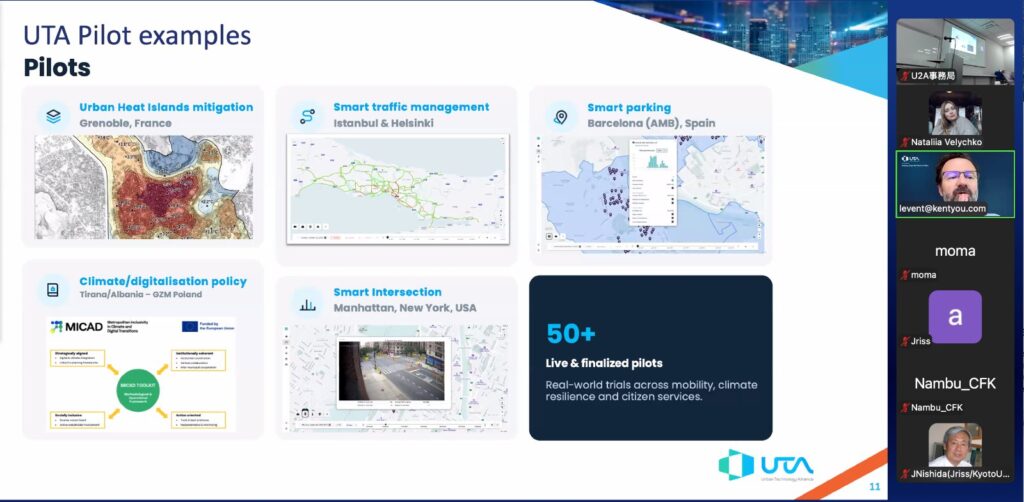
Based in Geneva, UTA now includes 38 member organisations and 26 member and partner cities across three continents and has run more than 50 pilot projects.
Dr Levent Gürgen described this evolution as a transition from the technology-driven “smart city winter” towards a new “spring” centred on practical urban challenges and measurable impact.
UTA’s pilots show this approach in practice. In Istanbul and Helsinki, an AI-based smart intersection system uses IoT infrastructure and data analytics to improve traffic flow and road safety. In the Barcelona metropolitan area, Kentyou Eye turns data from loading and unloading zones into insights for city logistics policy. In Grenoble, Earth observation, AI analytics and a 3D digital twin help the city tackle urban heat islands.
“Our global testbed approach connects cities, industry and academia so that solutions can be tested where they matter most, in real urban environments. By sharing knowledge and results across cities, we can accelerate the adoption of solutions that work,” said Dr Levent Gürgen.
Turning climate and digital transitions into action
Dr Levent Gürgen also presented two major Horizon Europe projects in which UTA and its members play a leading role: URBAN-FLOW and MICAD.
Launched in January 2026, URBAN-FLOW addresses one of the challenges facing growing cities: how to manage limited public space while advancing climate neutrality. The project brings together 32 partners from 10 countries with a budget of €16.76 million. Valencia, Florence and Tampere are leading the first tests, while Edinburgh, Brussels and Pilsen will adapt and replicate the solutions.
UTA coordinates governance across the climate and digital transitions and leads stakeholder engagement, validation and communication. Three UTA members are also consortium partners: Kentyou, Latitudo 40 and the Czech Smart City Cluster. The project is now entering its Living Labs and pilot phases.
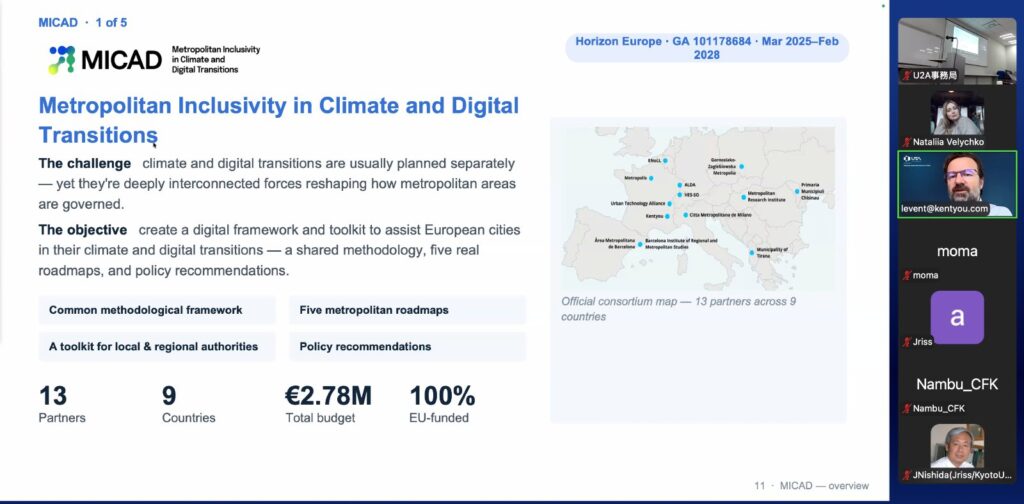
MICAD takes a complementary approach, helping metropolitan areas plan their climate and digital transitions together instead of separately. Five metropolitan authorities — Barcelona, Milan, Tirana, Metropolia GZM in Poland and Chișinău — are developing transition roadmaps using a shared methodology. UTA leads this process with its member Kentyou.
Where data meets the city
The Osaka meeting also showed how long-standing Europe–Japan research collaboration continues to shape smart-city innovation, with several UTA members featured in the programme.
Professor Toshiyuki Amagasa of the University of Tsukuba‘s Center for Computational Sciences, a UTA academic member, presented “Big Data Integration for Smart Cities”. He looked back on his earlier collaboration with Dr Levent Gürgen in BigClouT, a joint EU–Japan project funded by Horizon 2020 and Japan’s National Institute of Information and Communications Technology (NICT).
One of the project’s pilots took place in Tsukuba City, a UTA member city. There, the HukuRepo app gave foreign visitors real-time tourism, traffic and environmental information in English. It also let them report problems with photos and locations, and the system translated their messages automatically for the local people who responded. The app was tested with the public throughout November 2017 around Tsukuba Station and Mount Tsukuba. Its data also fed dashboards on visitor trends.
Professor Amagasa also shared work on lowering the cost of preparing data for analysis. He introduced the Verifiable Data Ecosystem, a national project designed to make AI-driven results traceable.
Digital transformation with people at the centre
Associate Professor Yin Chen of Reitaku University gave another practical example of digital transformation: digitalising Japan’s waste collection and recycling sector, known as the “venous industry”.
Dr Chen’s research began with sensors on waste collection trucks in Fujisawa, a UTA member city. This line of work is documented in UTA’s Fujisawa pilots from the EU–Japan projects ClouT and BigClouT — Waste Management in Fujisawa and Participatory Sensing and Waste-Truck Pollution Monitoring — which UTA member Keio University, NTT and Fujisawa City carried out. In those pilots, refuse trucks carried GPS and 13 environmental sensors. For the first time, the city had data on its actual collection routes, along with street-level air-quality readings it could share with residents.
His current system goes a step further. His team installed cameras and on-board computers in about 40 waste collection vehicles in Fujisawa, Kamakura and Yokosuka to count waste bags in real time. The vehicles transmit only the counts, never the images, which helps protect residents’ privacy.
The data helps the three cities understand collection demand and plan for the future. However, Associate Professor Chen stressed that technology is only one part of the transformation. Costs, operations and citizen participation are just as important.
A new chapter for Europe–Japan collaboration
The meeting also showed the growing ties between UTA and Japan’s smart-city ecosystem.
UTA’s Japanese members include the cities of Tsukuba, Fujisawa, Bibai and Saitama; the University of Tsukuba, Keio University and Nagoya University; and companies including NTT East, NTT R&D and JRISS. Several of them worked together in the Tsukuba and Fujisawa pilots, which shows how earlier EU–Japan research has grown into a lasting network.
Another opportunity is opening up through Horizon Europe. Since January 2026, Japanese organisations can take part in Horizon Europe Pillar II projects on the same terms as European partners, including joining or leading consortia and receiving EU funding.
For UTA, this opens a path from current relationships to new international projects, building on more than a decade of EU–Japan cooperation.
Explore all UTA pilots at urbantechnologyalliance.org/pilots.