Securing Mobile Sensing and Affective Participatory Reporting in Japan’s Pilot City

✅ Finalized

📍 Fujisawa, Kanagawa, Japan

About

🗓️ Start: 2018-07-01

⇨

🗓️ End: 2021-09-30
NTT East, Keio University and Fujisawa City ran the Japanese side of M-Sec, the EU–Japan project on multi-layered smart city security. Two use cases took place here: securing an operating mobile sensing platform end to end, and letting residents report on city life by photograph without giving up their privacy. Both fed a cross-border data marketplace shared with Santander.

Short Description

Fujisawa served as the Japanese pilot city for M-Sec, working alongside Santander in Europe. Its involvement was significant, with two of the project’s five use cases taking place there, and it was a key site for the cross-border marketplace trial. NTT East coordinated the Japanese side, and Keio University led both Fujisawa use cases, while the city itself acted as host and operating partner.

Importantly, the Fujisawa work built on an existing mobile sensing platform that Keio had already operated with the city for over three years through the earlier ClouT and BigClouT projects, rather than starting from scratch. Use Case 3, the Secure and Trustworthy Mobile Sensing Platform, extended that system — sensor-equipped refuse collection vehicles — to monitor restaurant ventilation, bus ventilation and classroom air quality, with security added at every stage. Use Case 4, Secure Affective Participatory Sensing of City Events, used SmileCityReport, a mobile app that let residents report city events with photographs shared securely within defined groups. Both contributed data to Use Case 5, the cross-border blockchain marketplace shared with Santander.

City: Fujisawa, Kanagawa Prefecture, Japan

Pilot Overview

Fujisawa is a coastal city in south-central Kanagawa with about 429,000 residents across 69.6 km². It is a commuter hub for Yokohama and Tokyo and draws many visitors to Enoshima and the Shonan beaches. The city is home to Keio University’s Shonan Fujisawa Campus and the Fujisawa Sustainable Smart Town, and had already launched smart city programmes such as Fujisawa SST and G-Spatial before M-Sec. Its planning priorities — citizen wellness, disaster prevention, traffic safety and crime reduction — became more pressing still when the city hosted events for the Tokyo 2020 Olympic and Paralympic Games. Fujisawa is a UTA member city.

M-Sec — Multi-layered Security technologies to ensure hyper-connected smart cities with Blockchain, Big Data, Cloud and IoT — was funded by the European Commission under Horizon 2020 and by Japan’s National Institute of Information and Communications Technology. It ran from 1 July 2018 to 30 September 2021 with 12 partners from Spain, France, Greece, the UK and Japan, and tested its security stack in two pilot cities: Santander and Fujisawa.

The sensing platform had been running with the city for more than three years by the time M-Sec began — the sensor-equipped refuse collection vehicles that started under ClouT (2013–2016) and continued through BigClouT (2016–2019). M-Sec’s contribution was not another sensing deployment but an answer to the question the previous two projects had left open: how do you secure a platform like this, end to end, when it is open by design, spans multiple device manufacturers and distributes data to third parties?

The second Fujisawa strand went in a different direction: participatory sensing, with citizens reporting on their city through their phones. The research group had already shown this was possible with MinaRepo during BigClouT, but had not addressed how to protect the private information those reports contain. Photographs of city events can include faces, licence plates, house numbers and other details people may not intend — or even notice — that they are sharing. Use Case 4 set out to solve that.

The pandemic reshaped both strands. Use Case 3 lost access to the city staff and cleaning companies it depended on, so much of it had to be conducted and verified at laboratory level rather than as a full field trial. Use Case 4 shifted from physical events to online participation, which — unexpectedly — is what made its second phase large enough to produce meaningful numbers.

Challenges Addressed

The Fujisawa work addresses four challenges.

First, securing an open sensing platform from end to end. A smart city IoT platform is valuable because it is open, scalable and able to collect and share many different kinds of city data. Those same qualities make it hard to secure. The challenge was to add protection at device, transport and cloud level without closing the platform down.

Second, privacy in citizen photography. Participatory sensing depends on people photographing their surroundings, and photographs incidentally capture identifying information. The methodology had not previously explored how to protect it; Use Case 4 focuses on exactly that.

Third, trading city data across jurisdictions. Moving data between Japan and Europe raises questions of confidentiality, regulatory compliance under both GDPR and Japan’s APPI, and the risk of sensitive information being uploaded to a marketplace by accident.

Fourth, running a field pilot through a pandemic. Restrictions removed the stakeholders and the public events that both use cases had been designed around.

Solutions Tested

Expected Results and Outcomes

The main goal was to test M-Sec’s multi-layered security stack in a real Japanese city: to show that an existing urban sensing platform could be secured end to end without losing its openness or scalability, that citizens could share photographs of city life without giving up their privacy, and that data originating in Japan could be traded securely with a European city through a shared blockchain marketplace.

Current Status

Completed

Achieved Results

The participatory sensing strand ran in three phases. The first took place at Fujisawa Jazz Meetin’ 2020 on 7 November 2020. The second, held entirely online because of the pandemic, drew 250 active users who created 1,340 posts. The third involved 40 participants from Fujisawa and Santander, who exchanged 46 posts between the two cities.

That cross-border exchange was the standout result: people in Japan and Spain used the same secure platform to share city reports despite not sharing a language. It showed that strong security and privacy features can make cross-border citizen data exchange work in practice, not only in theory.

Use Case 3 established a solid base for secure urban sensing. The project produced a flexible, scalable IoT platform that collects and shares varied city data while balancing security against the openness smart city work requires. Security was added to an existing platform rather than a purpose-built one, and the sensing fleet grew beyond refuse vehicles to restaurants, buses and classrooms.

The cross-border trial showed a secure data marketplace is feasible: different data types could be exchanged and traded once strong security was in place. Data from Use Cases 1 to 4 was combined in encrypted and anonymised form, and participants in both cities used the marketplace successfully, suggesting the approach could transfer to other European and Japanese cities.

At project level, M-Sec produced 13 prototype demonstrators, a final integrated prototype, 20 technical deliverables and four peer-reviewed publications on blockchain performance, IoT data marketplaces, smart contract analysis and location-verification protocols. The work also continued a long-running EU–Japan effort in Fujisawa — three projects over eight years. The sensorised refuse fleet began with ClouT in 2013, expanded with BigClouT from 2016, and was secured end to end under M-Sec through 2021. Keio University was involved throughout; NTT East joined from BigClouT onward.

Lessons Learnt

COVID-19 constrained both use cases, in different ways. Use Case 3 lost the Fujisawa City staff and cleaning companies it relied on, so experiments and checks had to be done largely in the lab rather than in real-world trials. Use Case 4 lost its in-person city events and moved fully online — which allowed more people to take part than a single event would have, but shifted the focus from event sensing to online reporting. It also brought inconsistent quality across Android devices and limited translation capability: citizens could participate across the language barrier, but the experience was constrained by it.

The marketplace was difficult for non-experts to use. The way keywords and menus were presented made handling encrypted data hard for people without technical knowledge, and the team concluded that more development would be needed before it could be used more widely.

Recruiting participants, not the technology, was the main challenge. The pandemic cancelled the exhibitions and seminars meant to attract stakeholders to the marketplace trial, so large-scale testing never happened. The pilots showed that the system worked — but not how it would perform at scale.
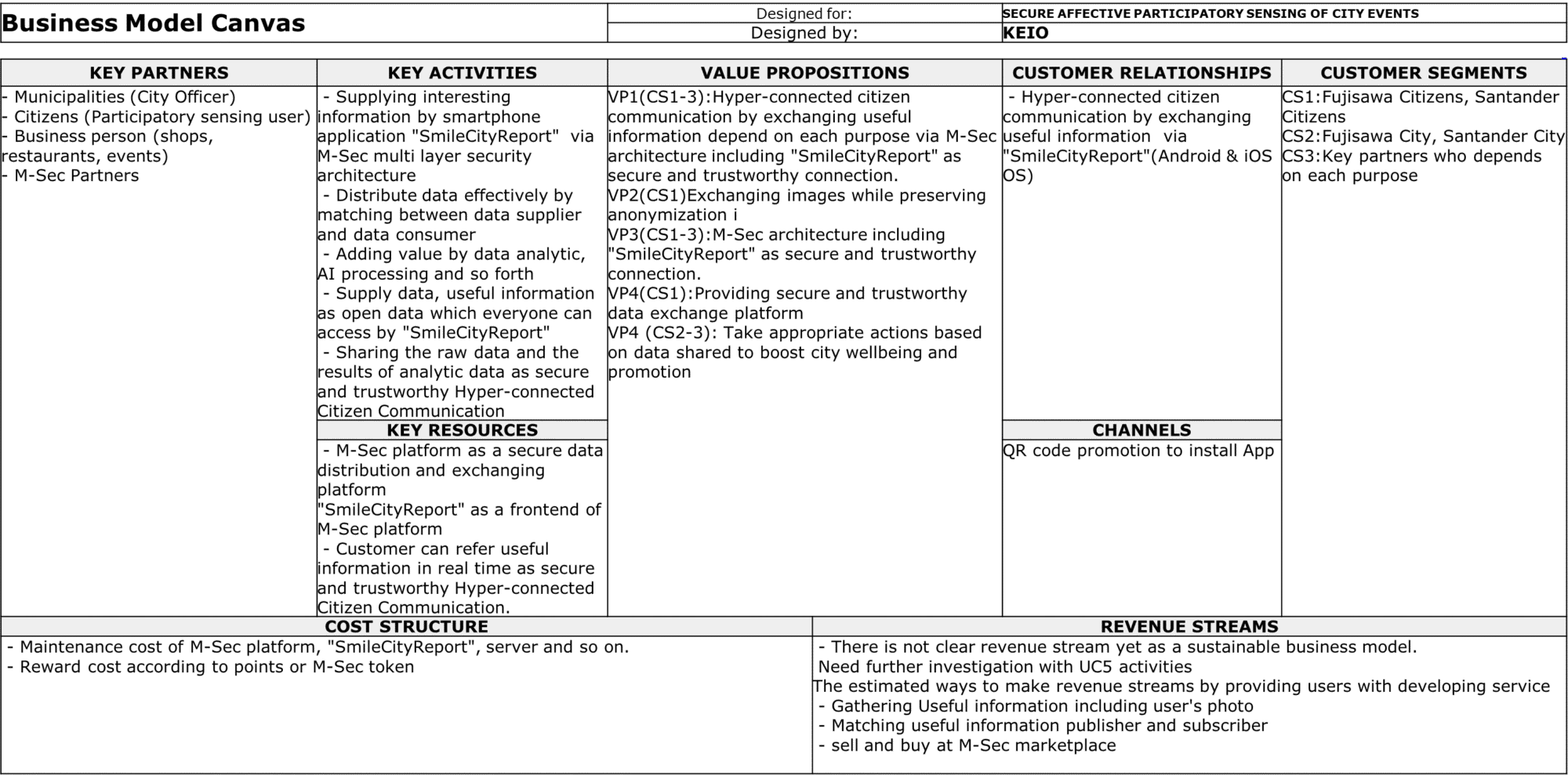
Business Model Canvas for M-Sec Use Case 4, Secure Affective Participatory Sensing of City Events, designed by Keio University

Use Case 4 business model canvas. Source: Keio University, M-Sec.
Use Case 4 Product Sheet (PDF)

Innovators

Share the Post: