
✅ Finalized
⇨
The “Home Monitoring Security System for Ageing People” pilot was M-Sec’s Use Case 2. It aimed to solve a key challenge in helping older people live at home. In the past, tele-assistance meant users had to press a button for help. Now, sensor-based monitoring tries to spot emergencies automatically, but it means collecting personal data all the time, such as when someone gets out of bed, opens a door, or moves around. This data is useful, but it can be risky if not kept secure. Worldline led the pilot and built the Senior Care platform. Atenzia, a tele-assistance provider, ran the system, and Santander City Council helped with deployment. The pilot tested whether the M-Sec security stack could make continuous home monitoring safe enough for both providers and users to trust.
The demographic challenges are clear: people are living longer due to medical, social, and economic progress; family ties are weaker; more older people live alone; and demand for social services is increasing. The COVID-19 crisis made these issues even more urgent. Usually, the response has been to install sensors in homes, but less attention has been given to the security risks of doing this on a large scale.
Home monitoring keeps a continuous record of when someone is in bed, moves around, or opens a door. Together, this data shows a detailed picture of an older person’s daily routine and when they are not at home. This kind of information could be used by someone with bad intentions to track or target a person. That’s why the pilot focused on security, not just health. The main barrier for IoT applications like this is not the sensors, but making sure the data they collect stays safe and private.
M-Sec — Multi-layered Security technologies to ensure hyper-connected smart cities with Blockchain, Big Data, Cloud and IoT — was the EU–Japan project in which this was addressed. It ran across a consortium of 12 partners in Spain, France, Greece, the UK and Japan. It worked in two pilot cities — Santander and Fujisawa — across five use cases spanning reliable IoT devices in city parks, well-being monitoring, environment sensing, hyper-connected citizen care and an IoT services marketplace.
Worldline’s Senior Care is an IoT platform that helps tele-assistance companies digitalise the services they already offer, instead of creating a new product for consumers. This approach shaped the pilot: Atenzia, an experienced provider with over 25 years in the field, ran the system, and participants were from Atenzia’s existing user network. This meant the system was tested by the people who would use and manage it.
The field pilot ran from September 2020 to September 2021. Five participants received a home sensor kit with a gateway, a bed occupancy sensor, a movement sensor, a door/window opening sensor, and a smart plug. Pre-set rules turned sensor patterns into emergency and unusual-behaviour alerts for the tele-assistance operators.
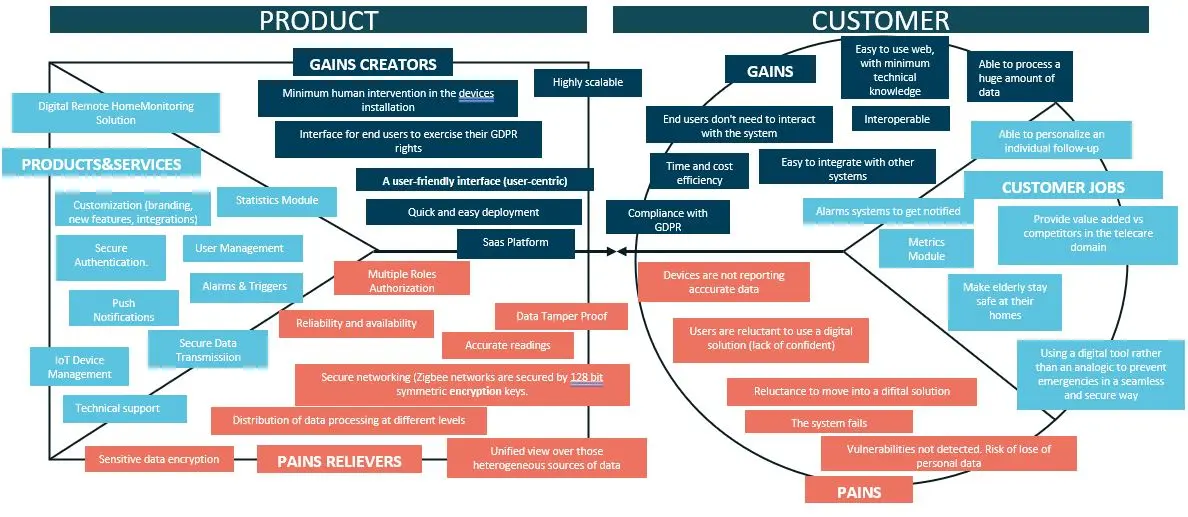

The pilot tackled two challenges—one demographic and one technical—which the project saw as closely linked.
First, current tele-assistance models are under pressure. People are living longer, family ties are weaker, more people live alone, and demand for social services is rising. The COVID-19 crisis made these risks clearer, so it is important to rethink well-being services and find new or complementary models, especially for those at risk because of age, frailty, loneliness, or dependency—and the privacy of the data collected. The project identified this as the main barrier to using and scaling IoT applications like this. Home sensors constantly collect personal information that could be misused by a malicious actor. GDPR compliance alone is not enough to prevent outside attacks. If the data stream is compromised or altered, a tele-assistance company might act on false information, which could directly harm vulnerable users.
Third, trust is essential. Both providers and residents need to feel sure that the data is secure and that alerts are reliable before they will accept continuous monitoring.
The goal was to help tele-assistance providers move from button-press alerts to continuous sensor-based well-being monitoring. This meant going beyond GDPR compliance by adding access control, verifiable storage integrity, and built-in data-subject rights. These steps make sure that sensitive home data cannot be secretly changed, stolen, or misused, so both providers and users can trust the system.
Completed
Atenzia, which ran the pilot, was happy with how easy the solution was to use and how it looked, as well as how simple it was to install the home sensors in users’ homes. Staff felt that Senior Care solved their problems, felt safe using it as their current system, and trusted the reliability of the information it provided. They especially liked how easy it was to spot unusual behaviour in users through the alert system. They felt the system and the M-Sec project helped address current security concerns about data protection and build user trust.
Participants reported feeling safer with the new sensors in their homes, though one person felt equally secure with or without them. In the project’s final account, all participants with sensors said they felt safer. Regarding privacy, everyone agreed they never felt their privacy was invaded, and the installation caused no inconvenience.
On the technical side, the pilot fully integrated a commercial tele-assistance platform with the M-Sec security stack. This included sensiNact for interoperable data collection, the Security Manager for access control, the Blockchain Middleware for data integrity, and the Marketplace for anonymised data exchange. All of this ran in a real production environment with actual users in their homes, not just in a lab.
M-Sec delivered 13 prototype demonstrators across its security domains, an integrated final prototype, 20 technical deliverables including architectural specifications and GDPR compliance assessments, and four peer-reviewed publications on blockchain performance, IoT data marketplaces, smart contract analysis, and location verification protocols.
Lessons Learnt
Bed occupancy sensors did not work properly. The issue was with the connection between the mattress and the sensor. The team reported this to the device supplier.
The integrated prototype ran into production problems that the development environment had not surfaced. After completing and testing all integrations with sensiNact, the Security Manager, the Marketplace and the Blockchain Middleware in development, the software was promoted to production by the standard procedure — and new problems appeared. Downtime in the Blockchain Middleware and the Marketplace, caused by the major wildfires in Greece, had to be worked around by writing new software at speed: a “bridge” that allowed the system to keep functioning without communicating with those components. Building it under that time pressure was challenging. Separately, stress testing of the Security Manager made the servers unstable for some days, producing a communication problem: the Crypto Companion Database is secured by the Security Manager and could not be accessed stably to save and retrieve data because security was entirely delegated to the Security Manager; no satisfactory way to resolve that downtime was found.
A missing feature became clear during use. Although there was a way to export sensor data for analysis, Atenzia needed another option: the ability to export aggregated data across all users on the platform so that they could prepare a report for the municipal Social Services about the pilot’s results.
Taken together, these are the pilot’s main lessons. Relying on a security manager as a single point of failure for the database, and on blockchain components hosted in another country, brings important design risks. Anyone building a distributed security system for a critical service should keep these issues in mind. As of 30 September 2021, Senior Care is still a Worldline solution, not just a project artefact, and Atenzia has continued to work on sensor-based tele-assistance, including later European projects on predictive tele-assistance.