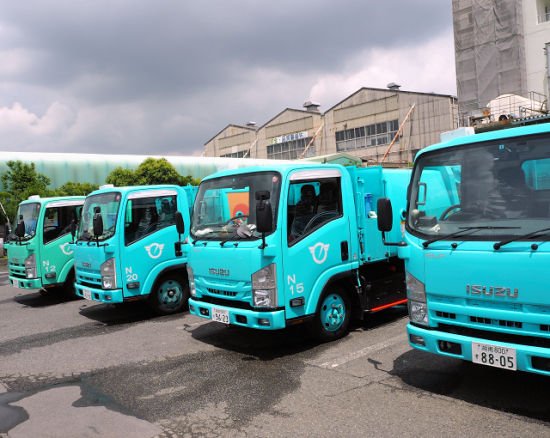
Cities usually measure air quality at a small number of fixed stations and estimate conditions everywhere in between. For pollutants that vary over short distances — dust, traffic gases, pollen — that leaves most streets unmeasured. Adding enough fixed devices to close the gap means more sites, equipment, power, permits and maintenance, a cost few cities can justify for monitoring no regulation requires.
Refuse collection vehicles already travel every street on a predictable schedule. Fitting them with environmental sensors turns those rounds into a moving survey of the city at very little marginal cost. In Fujisawa, each vehicle carried a custom sensor board running a CIL-based virtual machine developed by NTT, with a u-blox C027 mbed board for communications. GPS positions were logged every second and readings were sent over 3G every 30 seconds to a remote server using XMPP.
Because the routes repeat, the data is consistent over time as well as dense in space. The same dataset serves two audiences: residents get street-level pollen and PM2.5 information to plan their day, and the city gets location and route data it can use to optimise collection rounds, reducing mileage and CO₂ emissions.
– Thirteen atmospheric parameters: carbon monoxide, ozone, nitrogen dioxide, two further pollutant gases, dust, PM2.5, pollen, light, UV, temperature, humidity and background noise
– GPS positioning every second, data transmission every 30 seconds over 3G
– Custom sensor board with a CIL-based virtual machine (NTT) and u-blox C027 mbed communications board
– XMPP messaging to a remote server and into the BigClouT city data platform
– Route and location data reusable for collection-route optimisation
Get in touch to explore deployment opportunities or propose a complementary approach.
To provide the best experiences, we use technologies like cookies to store and/or access device information. Consenting to these technologies will allow us to process data such as browsing behaviour or unique IDs on this site. Not consenting or withdrawing consent may adversely affect certain features and functions.