✅ Finalized
⇨
Fujisawa is a coastal city in south-central Kanagawa Prefecture, home to about 440,000 people across 69.6 km². It sits on Sagami Bay between Tokyo and Yokohama, has a large commuting population, and draws visitors to Enoshima and its beaches. Keio University’s Shonan Fujisawa Campus, which led this pilot, is based in the city. Fujisawa has served as a testbed for several EU–Japan smart city research projects and is a member of the Urban Technology Alliance.
The park and public realm maintenance pilot, part of BigClouT, set out to replace Fujisawa’s paper-based maintenance reporting with a digital one. Field staff recorded defects, illegal dumping and repair needs on paper; those reports then had to be transcribed, sent to the right department and tracked by hand, which produced delays, lost reports and no reliable record of recurring problems. UTA members Keio University and NTT East worked with Fujisawa City to deliver the pilot, built around MinaRepo, a participatory sensing application that lets city officers capture geolocated, photographed reports in the field and send them through a shared digital workflow.
Municipal maintenance rarely attracts attention until it fails. In Fujisawa, officers inspecting parks and public spaces wrote down what they found on paper, sometimes photographing the problem separately and noting the location by hand. The records were carried back to the office, transcribed, assigned to a department and followed up manually. The result was delays, duplicated reports of the same fault, tasks that quietly went missing, and no overall picture of which facilities were failing repeatedly.
BigClouT — big data meeting Cloud and IoT to empower citizen involvement in smart cities — was the EU–Japan project that funded the work. It was jointly supported by the European Commission under Horizon 2020 (grant agreement 723139) and by Japan’s National Institute of Information and Communications Technology, with each side funding its own partners. The project ran from 1 July 2016 to 30 June 2019, followed the earlier EU–Japan ClouT project, and operated in four pilot cities: Grenoble, Bristol, Fujisawa and Tsukuba, each testing the shared platform against a different urban challenge.
Jin Nakazawa’s laboratory at Keio University’s Shonan Fujisawa Campus developed MinaRepo as Fujisawa’s answer. Its distinguishing choice is who reports. Unlike citizen-facing systems such as FixMyStreet, MinaRepo treats civil officers as the primary reporters: they already cover the city as part of their jobs, they know what they are looking at, and their reports arrive pre-validated, which removes the triage work that open citizen reporting creates. The research was published as “Accelerating Urban Science by Crowdsensing with Civil Officers” at UbiComp/ISWC 2018.
In Fujisawa the system covered illegal dumping, waste disposal errors, missed collections, graffiti, and defects in parks and public facilities. Reports were connected to a team collaboration platform so that information moved directly to the staff responsible for the work. Alongside the reporting service, the city fitted refuse collection vehicles with thirteen types of atmospheric sensor, turning the collection fleet into a mobile air quality network and a source of route data for optimising collection — participatory reporting and sensor-based infrastructure management running on the same platform.
The pilot addressed four connected problems in municipal maintenance operations.
The paper workflow was expensive in staff time. Officers and back-office staff transcribed and manually routed field reports, work that added nothing to the maintenance itself.
Reports were delayed and lost. Every manual handover between observation and repair was a point at which a report could be held up, misrouted or dropped — and the city had no way of detecting which reports had gone missing.
There was no structured record to analyse. Paper reports could not be aggregated, so the city could not see which facilities failed repeatedly, where illegal dumping recurred, or how long repairs took.
Information did not cross departments. When an officer found a problem that another team had to act on, there was no shared view of its status between them.
A digital system replaced the paper-based maintenance workflow and was used in a working city department. Reports were captured, categorised, routed and tracked digitally from the moment of observation.
The pilot demonstrated and published a crowdsensing model built on civil officers rather than the general public, producing consistent, pre-validated urban data as a by-product of routine municipal work. It was shown at Keio’s Open Research Forum in 2017 and presented at UbiComp/ISWC 2018.
The approach travelled. MinaRepo was deployed in Fujisawa and its model was adopted across the wider BigClouT programme — the Tsukuba pilot’s HukuRepo used the same photo-and-description reporting pattern on the same platform, targeting foreign visitors instead of city officers.
BigClouT as a whole produced 11 conference papers and 3 peer-reviewed journal articles, together with around 10 smart city use-case scenarios and their associated business models.
What came next. The platform and its use-case patterns were transferred to the other BigClouT cities and into follow-on smart city work in Japan and Europe. Fujisawa has since opened a LINE-based citizen reporting channel for park facilities, extending to residents the reporting route the pilot first built for officers.
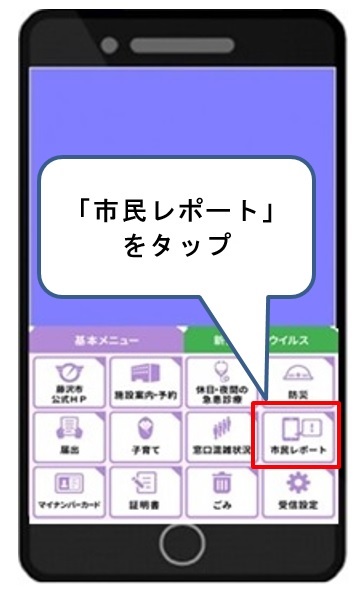
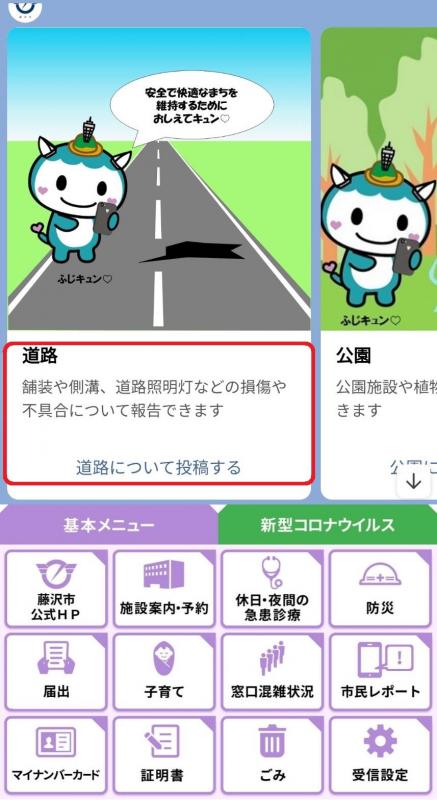
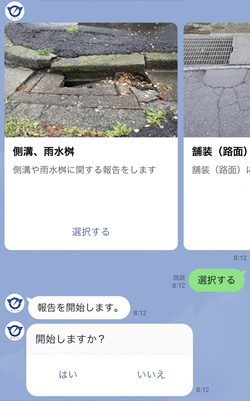
Fujisawa’s 市民レポート (Citizen Report) service: residents open it from the city’s LINE menu, choose a category such as 道路 (roads) or 公園 (parks), and a guided flow collects the defect type and a photograph — the same structured capture the pilot introduced for officers. Screenshots: Fujisawa City.