
3D Web and Virtual Reality Planning Consultation in Fingal

✅ Finalized

📍 Fingal, County Dublin, Ireland

About

🗓️ Start: 2020-04-01

⇨

🗓️ End: 2026-09-20
UTA member RealSim worked with Fingal County Council to make statutory planning consultation something residents can explore for themselves. Town-scale 3D digital twins of Balbriggan and Swords, published in a public web viewer and on VR headsets in local libraries, let people walk through proposed public realm schemes in their real context — at street level, at different times of day and in different seasons.

Short Description

Fingal County Council is the largest of Dublin’s four local authorities, covering about 450 km² of North Dublin and home to some 330,000 people in towns including Swords, Balbriggan and Malahide. Fingal is part of Smart Dublin, the regional initiative that uses Dublin as a testbed for new technologies to tackle urban challenges and improve public services.

In 2020, the Council’s Digital Services Department commissioned UTA member RealSim, a digital twin company, to build a virtual reality experience of the proposed public realm plans for Balbriggan Harbour and Quay Street for public and stakeholder engagement. The Department of Public Expenditure and Reform’s Public Service Innovation Fund provided €20,000 in seed funding. The project was conceived before COVID-19; when the pandemic made shared headsets impractical, RealSim proposed an online 3D viewer, which became the first deliverable.

Pilot Overview

Fingal’s public realm programme includes large, visually transformative schemes: the Our Balbriggan 2019–2025 Town Rejuvenation Plan, the redevelopment of Quay Street and the harbour in Balbriggan, and the Swords Cultural Quarter with a new civic building.

Consulting the public on schemes of this scale has traditionally demanded a lot from the Council and from residents alike. Plans, elevations and CGI stills make it hard to picture what a finished street or square will look and feel like from where you actually stand. The pilot set out to change that: to replace complex technical drawings with photorealistic, navigable 3D models that residents can explore from home, or in supported VR sessions in their local library.

Rather than modelling only the proposed development, the Council’s Digital Services Department and RealSim built a digital twin of the town itself. Each new intervention sits inside its existing urban context, so residents see it alongside the streets and buildings they know. Residents can explore the proposals from their own viewpoint instead of relying on fixed CGI images, and can switch between times of day and seasons to see how light, weather and planting change the scene. The VR version adds a full 360-degree experience at human street scale.

The original plan relied on VR headsets at in-person events. When COVID-19 restrictions ruled that out, the Council published the models through an online 3D web viewer so that people could take part remotely. That decision produced the hybrid consultation model the Council still uses today: always-on public access online, combined with supported immersive sessions in local libraries.

Challenges Addressed

The pilot addressed four connected challenges in public realm planning and civic engagement.

Planning information is hard to read. Planning and urban data can be difficult for residents to access and understand, particularly when it is presented through highly technical planning documentation.

Face-to-face engagement stopped overnight. The commission coincided with the outbreak of COVID-19, so the Council had to find a way to engage the public remotely, without the close contact that shared VR headsets would require.

Participation was low and unrepresentative. In-person consultation asks residents to attend at a fixed time and place. Balbriggan is Ireland’s youngest and most culturally diverse town — the average age is 33 and almost a third of residents were born outside Ireland — and both groups are traditionally hard to reach through conventional engagement.

2D materials hide scale and impact. Conventional plans and drawings struggle to communicate the scale, massing and potential environmental impact of a development, limiting residents’ ability to judge changes to sightlines, daylight and the overall experience of a street.

Solutions Tested

Current Status

Completed, with ongoing expansion of the Balbriggan and Swords digital twins for further town regeneration projects. The Swords model is being extended to analyse and communicate proposed improvements to Swords Main Street.

The models remain available through Fingal’s digital twins hub and the Balbriggan Quay Street & Harbour viewer.

RealSim has continued to develop the software since the pilot:

– EnviroSim Web Pro, an enterprise web solution that brings all the desktop analysis tools to a browser, with login controls for internal council use; the lighter public-facing viewer is now EnviroSim Web Lite
– All approved planning developments shown in Web Pro, updated every quarter
– A master-planning tool for conceptual building and greening strategies that needs no technical skills
– A solar potential map for the town roofscape
– A carbon calculator for proposed tree planting
– Connections to live IoT sensors


RealSim Digital Twin projects across Dublin — an overview of RealSim’s digital twin work across the Dublin region. Video: RealSim.

Achieved Results

More residents took part. The Balbriggan consultation received more than 100 public submissions, a substantial increase on comparable previous consultations. Participants showed a better understanding of the scale, massing and potential environmental impact of the proposals.

Fingal set a national first. It became the first local authority in Ireland to make an interactive 3D digital twin publicly accessible online, and the first to install VR headsets in local libraries so that anyone could try the immersive version. The viewer now serves as a national reference model for digital planning engagement.

The hybrid model became permanent. Always-on remote access combined with supported, in-person immersive sessions is now part of how the Council consults, and the programme grew from a single-town pilot into a multi-town, multi-project programme that the Council continued with its own funding after the initial grant.

Balbriggan Harbour and Quay Street — from engagement to construction
– April 2020: Ireland’s first publicly accessible 3D web viewer of a proposed public realm scheme launches
– March 2022: first VR headset version released on Meta Quest 2
– March 2023: third and final web iteration launches after two rounds of public consultation
– June 2023: the Council installs VR headsets in county libraries, with the Balbriggan and Swords models
– November 2024: scheme submitted for planning and approved
– March 2025 to September 2026: construction of the new harbour square
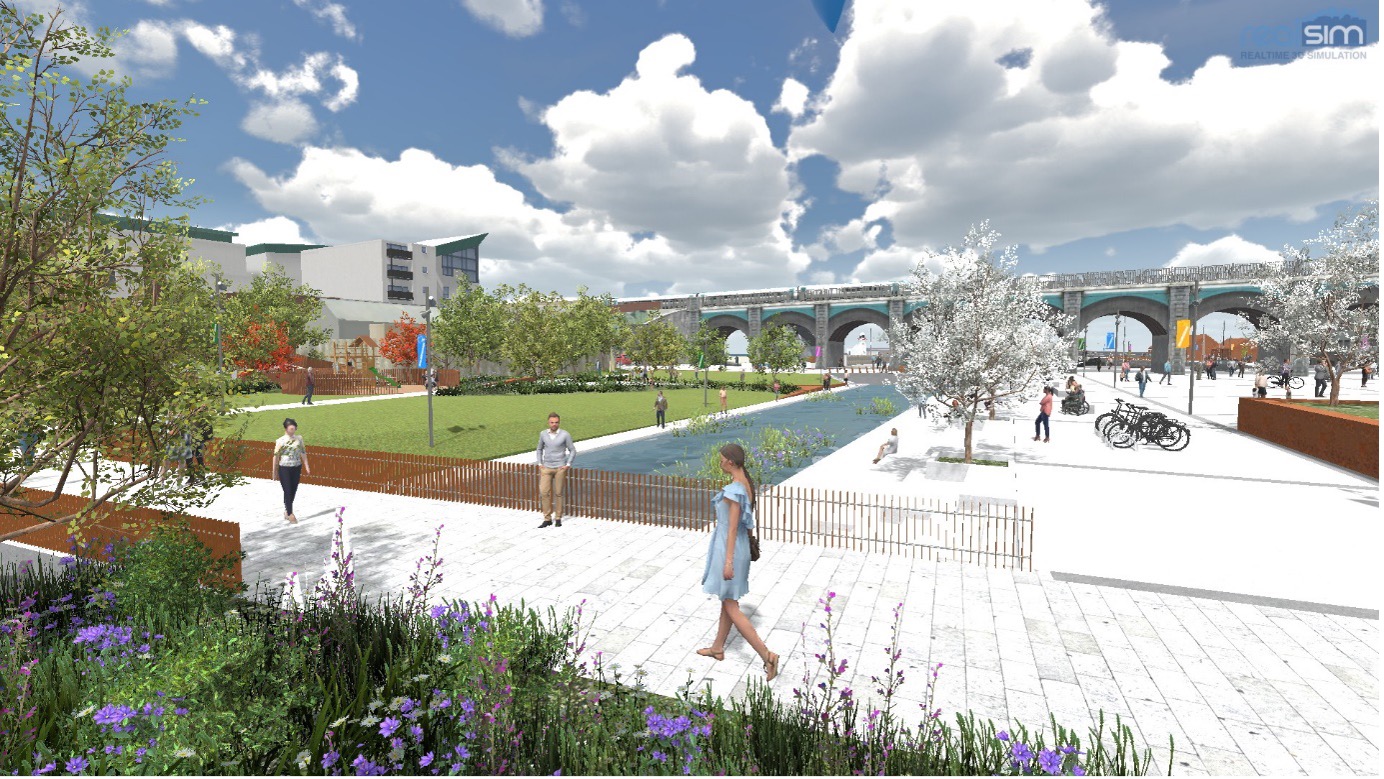
RealSim 3D model of the proposed Balbriggan harbour square, with lawns, a water channel, planting and the railway viaduct behind

The Balbriggan Quay Street and Harbour scheme in the digital twin, with the railway viaduct behind. Image: RealSim.

A Future Vision for Balbriggan Quay Street & Harbour — a walkthrough of the RealSim digital twin used in the public consultation. Video: Fingal County Council.

Swords Cultural Quarter and new civic building
– May 2022: web viewer launches
– June 2022: VR version delivered on Meta Quest
– August 2024: planning approval and start of construction, with opening due in early 2027
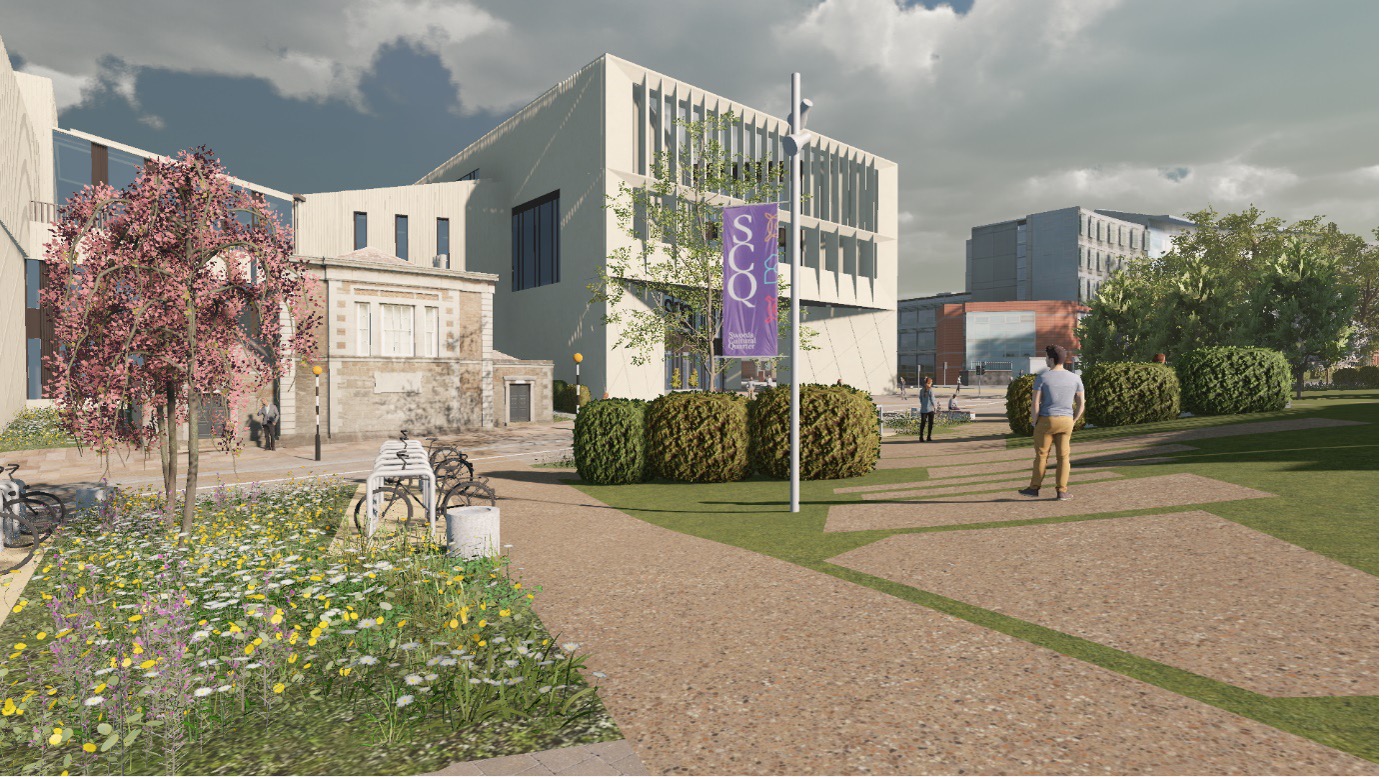
RealSim 3D model of the Swords Cultural Quarter and new civic building, with a landscaped path and an SCQ banner

The Swords Cultural Quarter and new civic building in the digital twin. Image: RealSim.

Swords Cultural Quarter Virtual Reality Model — the proposed Cultural Quarter and civic building in the RealSim digital twin. Video: Fingal County Council.

Recognition
– 2023: Winner, Communications category, Excellence in Local Government Awards
– 2024: Overall Winner, Ireland eGovernment Awards (19 September 2024)
– 2024: Winner of the Smart Cities & Urban Development Award, and of the Education Award for the VR for Libraries strand

Innovators

Share the Post: