
On 20 September 2026, Fingal County Council opened Harbour Square in Balbriggan. This €15 million, 19,300 m² waterfront plaza and linear park transformed the town’s historic Quay Street and harbour.
For the people of Balbriggan, however, this was not the first time they had seen the new square.
Six years earlier, they had already walked through it.
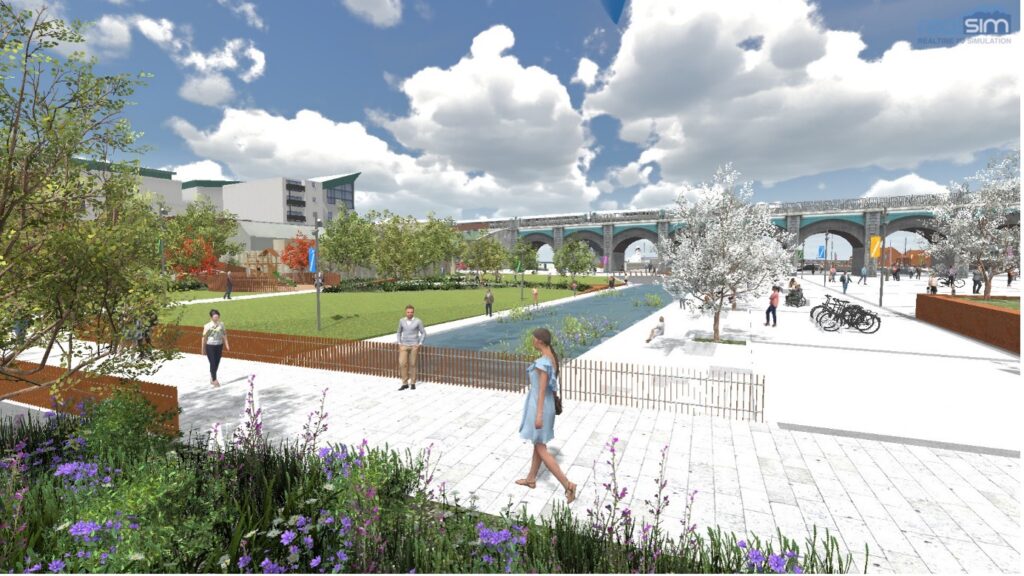
They explored the proposed streets and public spaces on a screen, then stepped inside them using virtual reality. They could look around, adjust the weather and time of day, and see how Quay Street might feel during a festival.
The square did not yet exist. But residents could already see themselves in it.
A place people could picture
Fingal County Council faced a common challenge. Large public projects take time and resources to explain and discuss, and traditional plans can be hard for residents to understand.
Architectural drawings, elevations, and CGI images can show what designers plan to build. But they do not always show what it will actually feel like to be there.
Balbriggan had another challenge. It is Ireland’s youngest and most culturally diverse town, with an average age of 33 and nearly a third of residents born outside Ireland. Traditional consultation methods often miss younger and more diverse groups.
Then COVID-19 changed the rules entirely.
As the project got underway, face-to-face engagement became impossible.
Fingal needed another way to bring the future scheme into the hands of the people who would use it.
Building the town before rebuilding the town
In 2020, Fingal County Council’s Digital Services Department commissioned UTA member RealSim, a Galway-based digital twin company, to create a virtual reality experience of the proposed Harbour and Quay Street scheme.
The Department of Public Expenditure and Reform provided €20,000 through its Public Service Innovation Fund to seed the pilot.
RealSim could have just modelled the new square. Instead, it created something much bigger: a geographically accurate digital twin of Balbriggan.
The team combined 3D mapping, architectural modelling and game-engine technology to recreate the town and place the proposed changes within it. Residents could explore the scheme from street level and see the proposals in the context of the streets, buildings and harbour they already knew.
They could change the time of day, season and weather. They could explore different views of the public realm. They could even see populated scenarios, such as a street festival taking place on a rejuvenated Quay Street.
The idea was simple. Instead of asking people to imagine the future from a drawing, let them experience it for themselves.
When the pandemic changed the plan
The original concept focused on immersive VR. But COVID-19 made one key part of that plan, sharing VR headsets, impossible. RealSim adapted.
The team proposed an online 3D viewer that people could access from their own devices, without installing specialist software. It became the pilot’s first public deliverable.
In April 2020, Fingal became the first local authority in Ireland to publish an interactive 3D digital twin online.
This change turned a project meant for in-person engagement into something that could reach people wherever they were.
Residents could explore the proposals from home. They could move through the streets, look around the harbour and understand the scale of the changes for themselves.
The digital twin became a new kind of consultation space.
From screen to street
The project kept evolving as technology and circumstances changed.
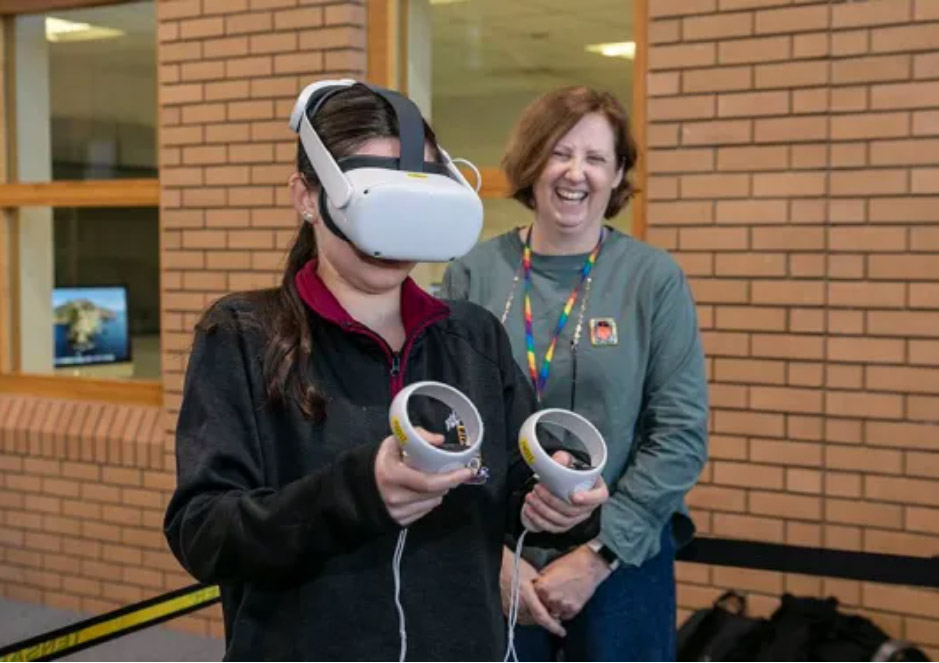
In March 2022, RealSim released the first VR headset version for Meta Quest 2. When COVID restrictions eased, Fingal brought the experience into local libraries, installing VR headsets and training staff as “VR Champions” to guide visitors through the experience.
Residents trying the VR version of the digital twin at a Fingal County Council community event. Photo: Fingal County Council.
The result was a hybrid approach. An always-available online viewer complemented guided, immersive in-person sessions.
The Council continued refining the web experience through further rounds of consultation. In March 2023, it launched the third and final web iteration.
By then, residents had not just seen a proposal. They had actually spent time inside it.
The wider project continued towards planning approval, which came in November 2024.
Then the future that residents had explored started to take physical shape.
Timeline
- 2020 — Fingal County Council commissions RealSim; the pilot receives seed funding from the Public Service Innovation Fund.
- April 2020 — Ireland’s first publicly accessible 3D web viewer for a proposed public realm scheme goes live.
- March 2022 — The first VR headset version launches on Meta Quest 2.
- March 2023 — The third and final web iteration launches after two rounds of public consultation.
- June 2023 — Fingal installs VR headsets in county libraries for the Balbriggan and Swords projects.
- November 2024 — The scheme secures planning approval.
- 20 September 2026 — Harbour Square officially opens.
“When we started in 2020, the goal was simple: let people stand in their own town and see what it could become, from their own point of view rather than a planner’s drawing. Seeing Harbour Square open this month, looking the way residents first explored it on a screen and in a headset, is the best possible outcome for a pilot. It shows that digital twins are not just a visualisation tool. They help communities shape real places, and they help councils build them with confidence.”
— Gavin Duffy, Founder and CEO of RealSim
Six years later, the model became real
When Harbour Square opened in September 2026, residents could finally experience the place they had previously explored virtually.
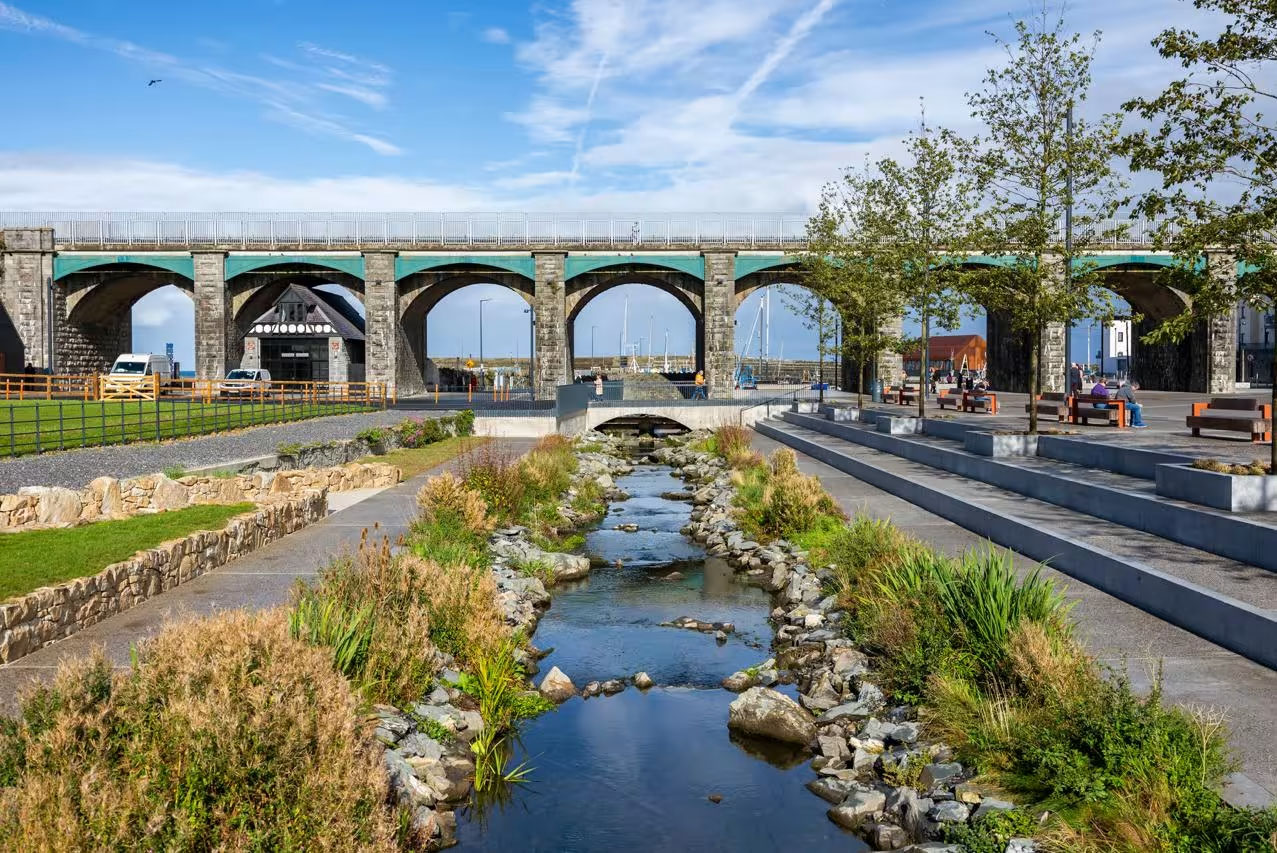
Harbour Square’s new landscaping and public realm along the River Bracken, with the Balbriggan viaduct behind. Photo: Fingal County Council.
The finished scheme includes a multi-purpose civic plaza, the restored 1889 RNLI boathouse, improvements to the River Bracken, new paving, seating and landscaping, and a reimagined Quay Street, Mill Street and Harbour Road.
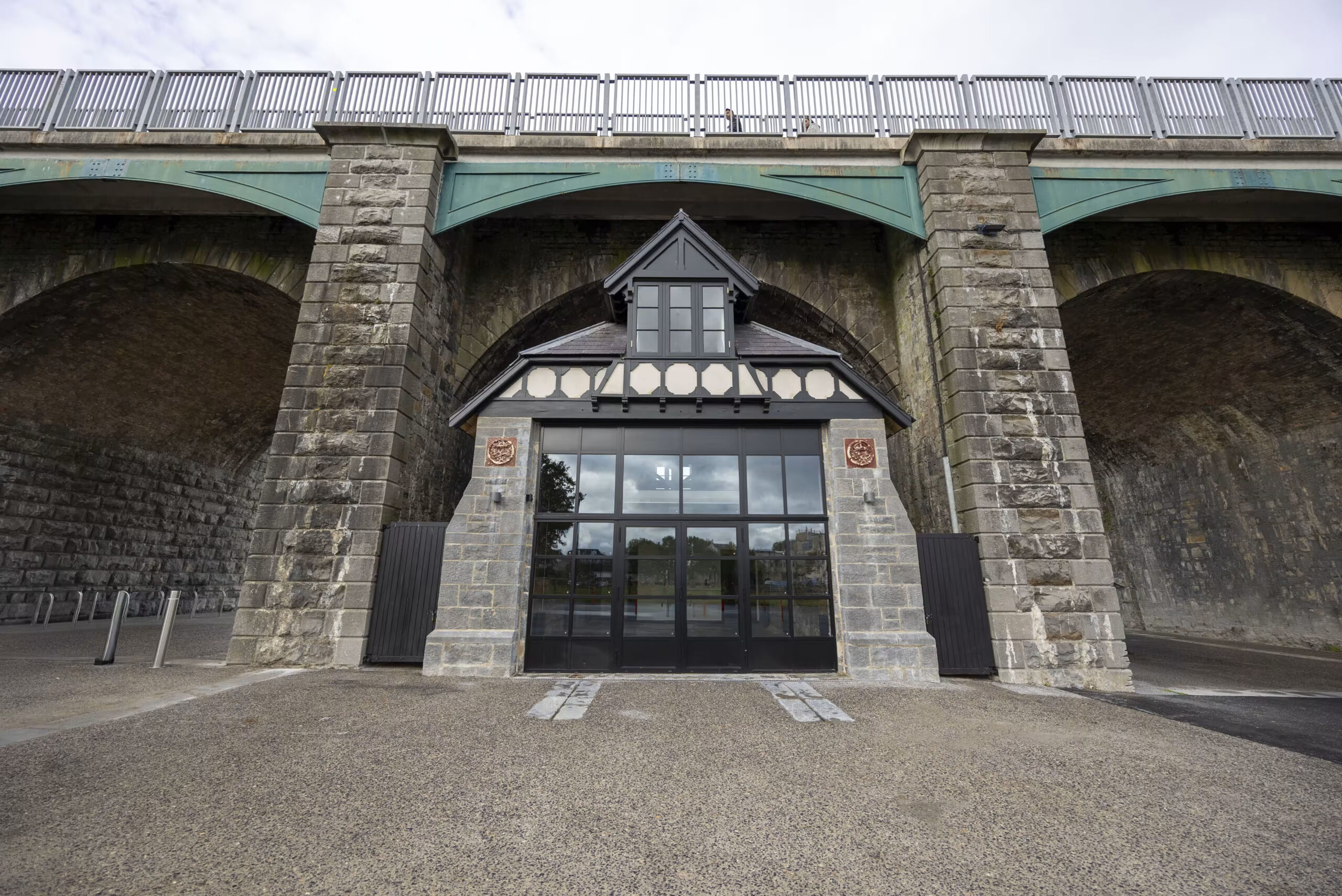
The scheme restores the former RNLI boathouse, built in 1889. Photo credit: Fingal County Council.
The square forms the flagship project of the Our Balbriggan Rejuvenation Programme, funded through the Government’s Towns and Cities Regeneration Investment Fund and Fingal County Council.
For the digital twin, this was the moment the virtual and physical worlds finally met.
The streets that residents had explored on their screens were now streets they could walk down. The spaces they had seen through a headset were now places where people could gather. The proposed square was now real.
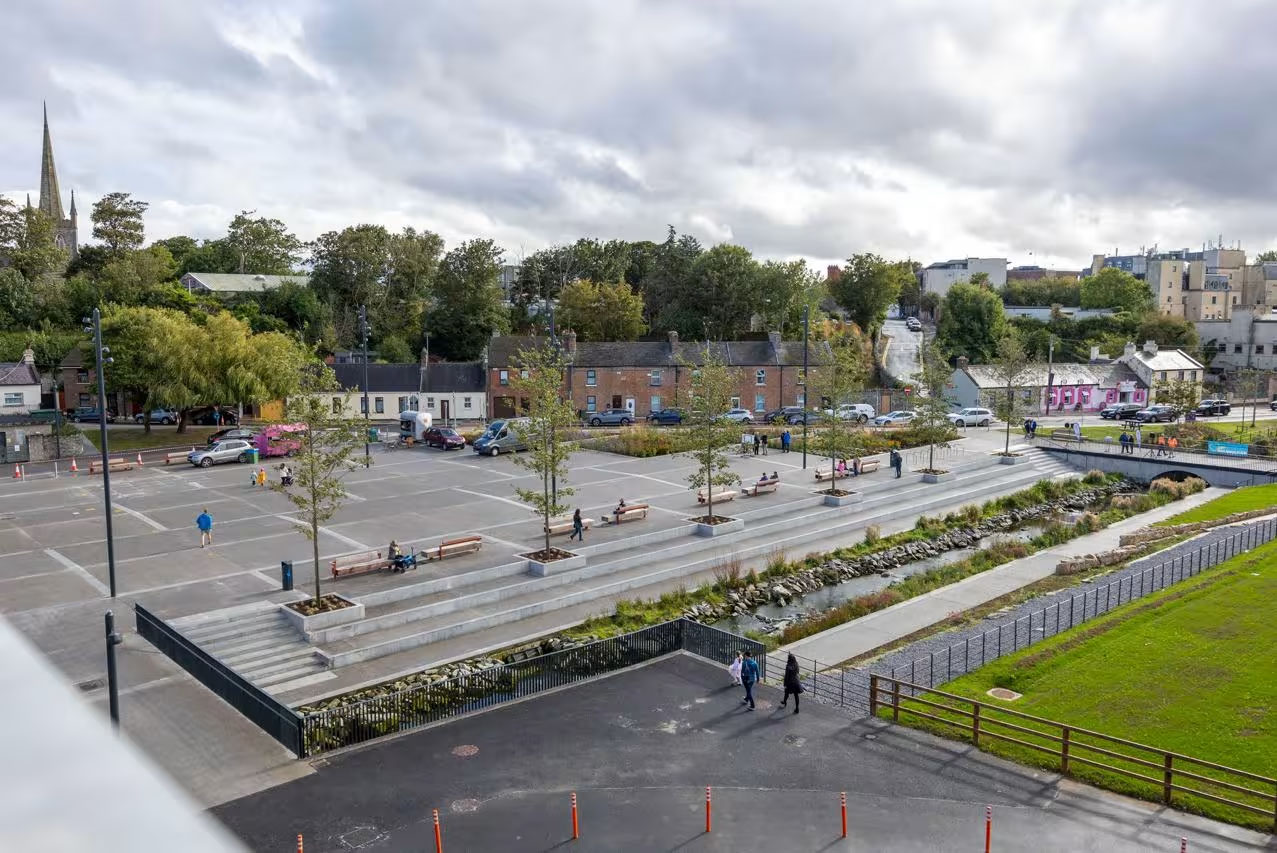
The new civic plaza and linear park along the River Bracken. Photo: Fingal County Council.
What changed?
The Balbriggan pilot demonstrated that digital twins could do more than make a planning proposal look impressive. They could change how people understood it.
The consultation attracted more than 100 public submissions, a marked increase on previous consultations. Residents also showed a clearer understanding of the proposals’ scale, massing, and possible environmental impact.
The project also established a new model for public engagement.
Fingal’s online viewer became Ireland’s first publicly accessible local-authority 3D digital twin. It also became a reference point for digital approaches to planning and public consultation.
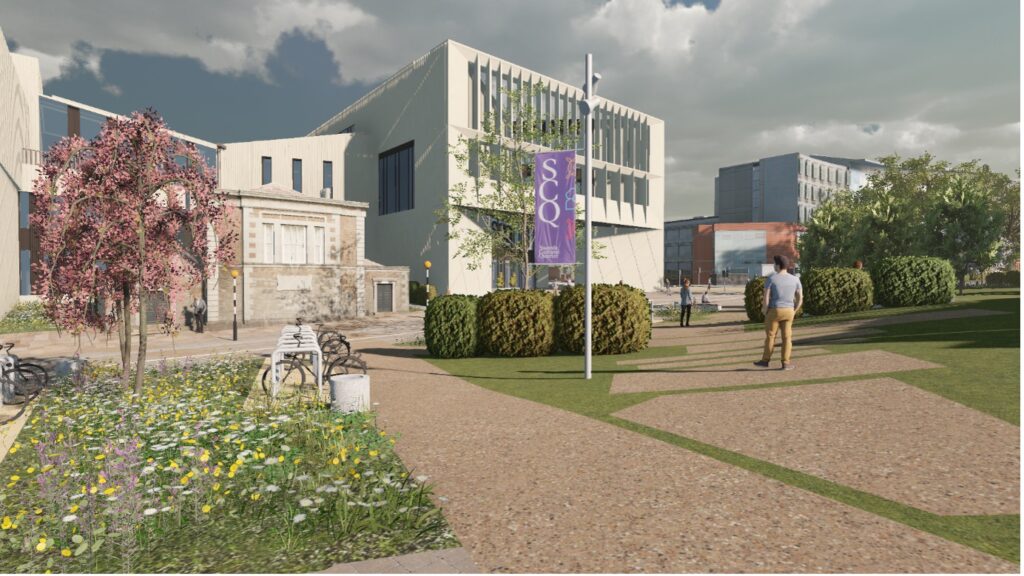
What began as a €20,000 pilot did not end with Balbriggan. Fingal continued to fund the approach and applied the technology to other projects, including the Swords Cultural Quarter, due to open in early 2027.
The work has also received national recognition, including the Communications category at the Excellence in Local Government Awards in 2023, the Overall Winner award at the Ireland eGovernment Awards in 2024, and awards for Smart Cities & Urban Development and Education for the VR for Libraries strand in 2024.
The next chapter
The digital twin has outgrown the original Balbriggan project.
Fingal and RealSim are extending the Balbriggan and Swords twins to support further regeneration work, including proposed enhancements to Swords Main Street.
RealSim has also developed EnviroSim Web Pro, a browser-based platform that gives council staff desktop-grade analysis tools, while EnviroSim Web Lite continues to provide the public-facing experience.
The newer platform adds features like quarterly updates on approved planning developments, a masterplanning tool that does not require specialist technical skills, a solar-potential map of town rooftops, a carbon calculator for proposed tree planting, and connections to live IoT sensors.
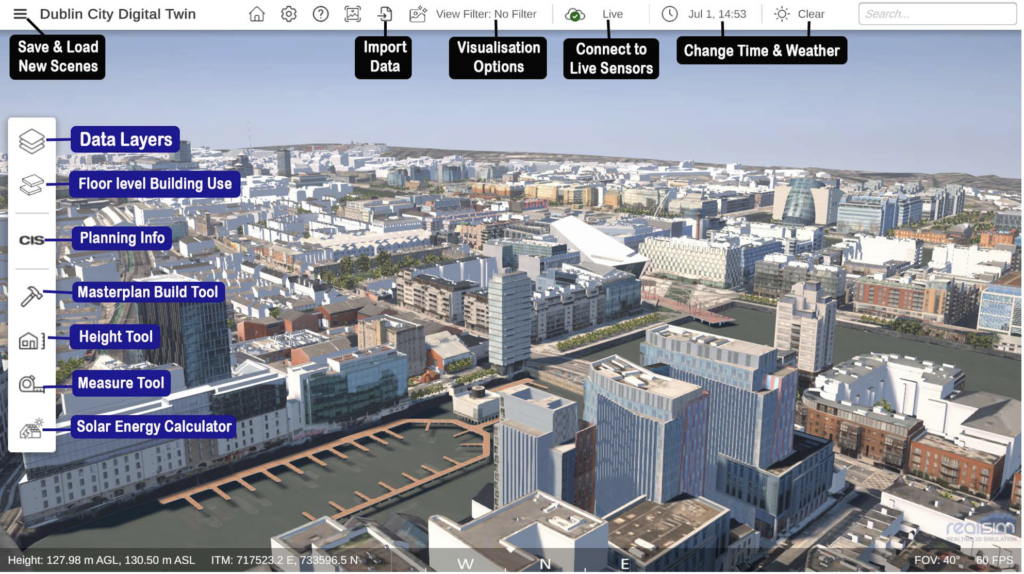
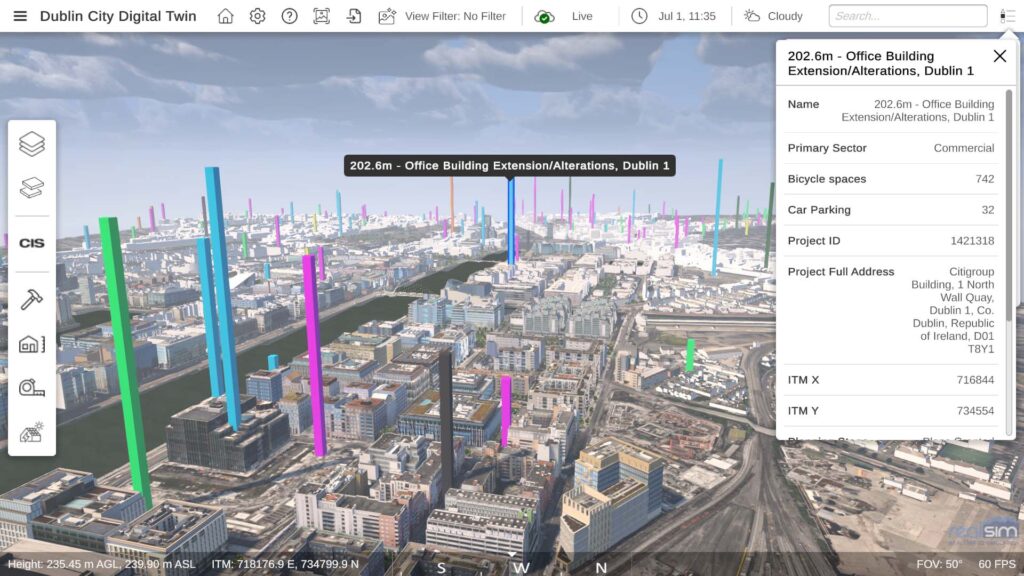
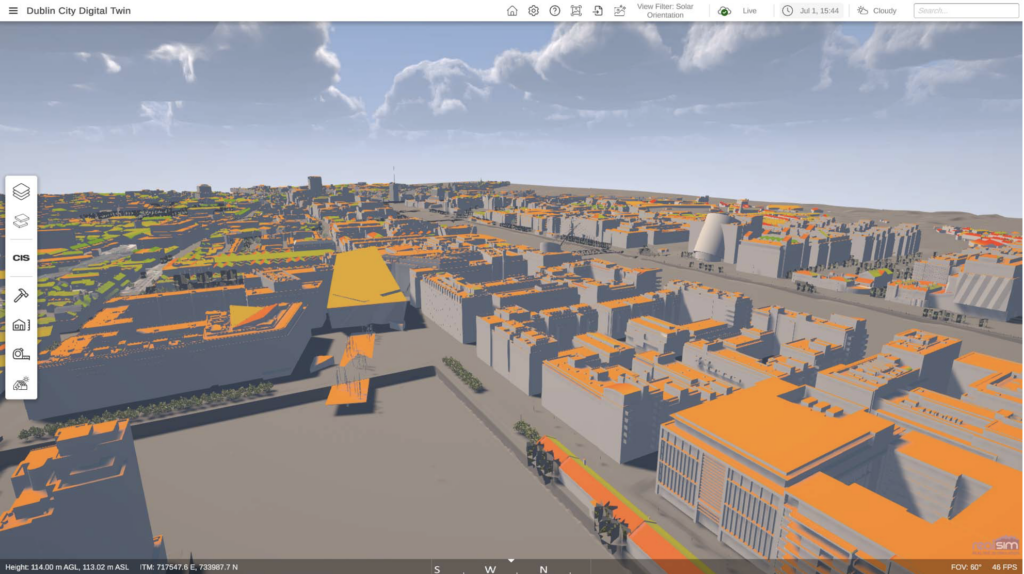
The goal has shifted from showing people a single future project to giving communities and councils a living digital model of their towns.
And that brings the story back to Harbour Square.
In 2020, residents stepped into a digital version of a place that did not yet exist.
In 2026, they stepped into the real thing.
Explore the digital twin
The models remain available through Fingal’s digital twins hub and the Balbriggan Quay Street & Harbour viewer.
About RealSim
RealSim is a UTA member, an Irish technology company founded in 2008 and based in Galway. It specialises in digital twins, interactive 3D simulation and immersive technologies for the built environment. RealSim combines geospatial data, 3D modelling and simulation to help cities and communities visualise proposed changes, explore different scenarios and make complex urban projects easier to understand.
The company’s work ranges from urban planning and public consultation to infrastructure, environmental analysis and heritage. The Balbriggan project shows how its technology can turn a planning proposal into an experience residents can explore themselves – both online and in virtual reality.
Want to bring a digital twin pilot to your city? Contact us.