
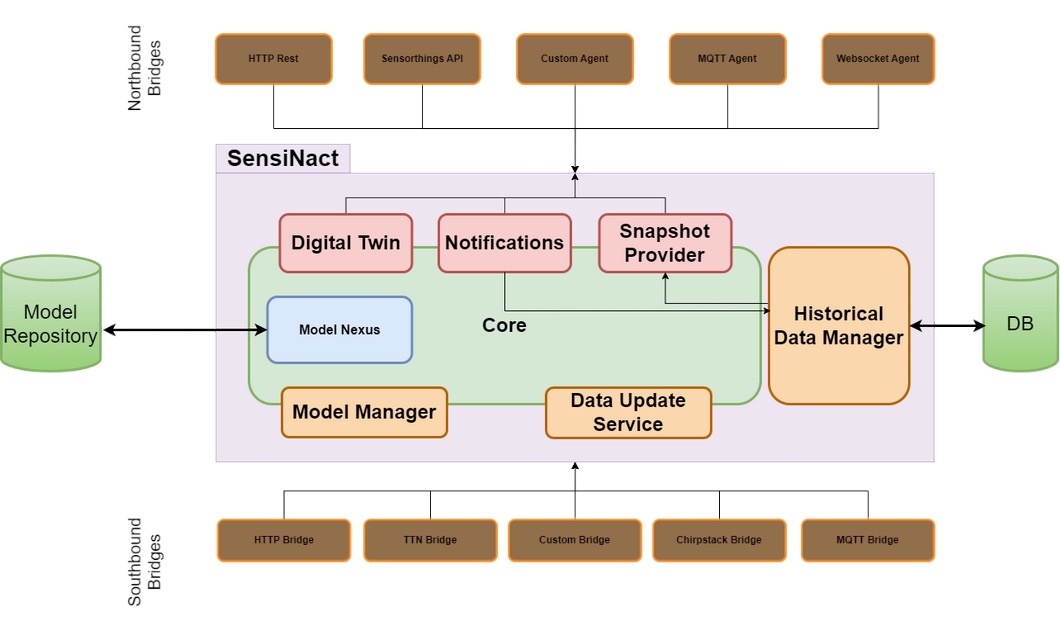
The sensiNact technology consists of a software platform enabling the collection, processing and redistribution of any data relevant to improving the quality of life of urban citizens. It allows programming of interfaces with different modes of access to data (on-demand, periodic, historic, etc.) and application development and deployment to easily and rapidly build innovative applications on top of the platform. SensiNact solutions shine with plug & play-readyness, modularity, are dependable as scalable and provide easy and quick growth for IoT applications.
We developed the sensiNact technology together with our UTA-Fellows from Kentyou: https://www.urbantechnologyalliance.org/portfolio/kentyou/
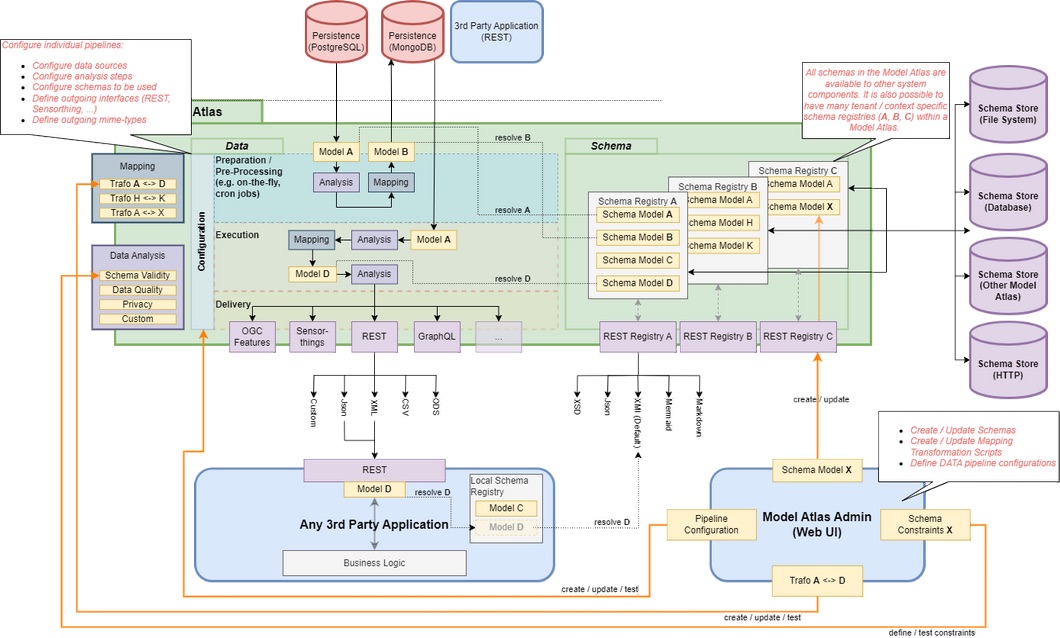
Our Model Atlas Technology provides an universal, modular and expendable framework for data transformation and conversion. It is our key enabler to connect data from various sources with distributed applications and let distributed components talk to each other. Key features include:
We combined a resource-efficient hardware setup with a specially trained detection algorithm to detect conflicts in road traffic – especially at accident hotspots. By combining data from optical traffic detection sensors, signal systems and position sensors (e.g. from public transport vehicles), potential conflicts between road users can be predicted in real time. For example, if turning vehicles crossing a cycle lane with poor visibility receive a green traffic signal, the system can generate a warning for every cyclist approaching the junction in certain predefined vectors, which can be played out in real time visually, acoustically or integrated into smart driver assistance systems.
With our Traffic Signal Detection System, we provide a solution to connect traffic light systems into smart city infrastructures. By using an easy-to-maintain hardware setup, we make traffic light phases and sensor inputs readable and transferable in real time. This solution enables municipal operators to access monolithic traffic light systems, which are often equipped with proprietary software. The collected real time traffic data can be used to implement smart switching systems into existing infrastructure without having to procure new traffic control technology. By pairing this data with streams from other data sources like traffic cameras, we offer a comprehensive data suite for facilitating real time traffic monitoring or enabling smart traffic control solutions, with nearly endless use case combination possibilities.
Urban data solutions often connect data from various sources, creating the demand for a comprehensive data protection and data transparency strategy. As an innovative solution for technically supported data protection, we offer a Model Privacy Analyzer. It is a tool for digital reporting and for supporting decision-making regarding data protection measures that can be used regardless of the use case or organizational area. Employing a model-driven approach to analyze both data structures and data objects in order to examine them for data protection relevance in a context-sensitive manner, the tool creates a privacy report. Depending on the use case, this data can then be automatically provided with an access restriction, anonymized or transferred into other data protection measures.
The analyzer uses our Model Atlas technology in an innovative two-stage process: In the first step, it analyzes the schema in question in order to assess its data protection relevance. In the second step, however, it can also check all instances of the various schemas in order to verify the existence of protection-relevant data and identify additional data that has not yet been found in the schema analysis.
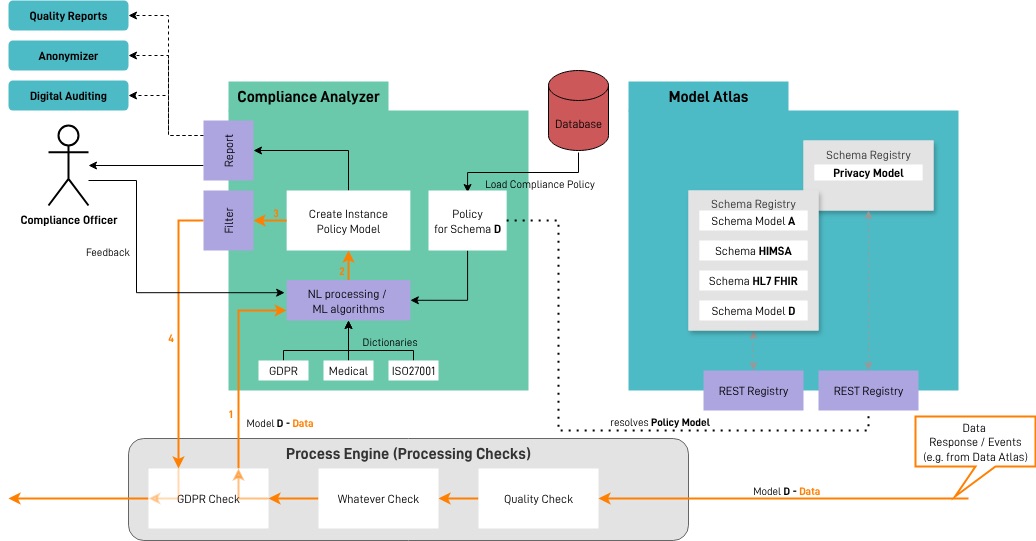
The result is a powerful tool that is suitable both for supporting existing data protection and data transparency measures as well as for supporting the legal requirements of the General Data Protection Regulation in areas and use cases where no off-the-shelf solutions are yet available.