
Data In Motion (DIM) was founded in 2010 in Jena, Germany, and has grown into a technology and knowledge provider for IoT, Smart City solutions, machine learning, digital compliance and digital transformation — serving public entities, B2B clients, and NGOs. We are actively involved in EU funded research and piloting projects across various sectors, and we contribute as committers and project leads to multiple Eclipse Foundation open-source projects.
Our team combines software engineering, data science, and modelling expertise with a broad interdisciplinary background spanning astrophysics, economics, and social sciences — enabling us to approach urban challenges from multiple perspectives and develop solutions that work technically and organisationally.
All our solutions are 100% open source, developed in collaboration with the Eclipse Foundation and city partners, and deployable without vendor lock-in.
We believe in open source as a way to provide digital enhancement for everyone. Our leadership are longstanding open-source contributors, committing our solutions to lasting, community-owned value.
Our mission is to unleash the potential of digital data to make interactions between people and organisations easier, increase data transparency and accessibility, and transform IT infrastructures into safer, more human-friendly, and more efficient tools — developing solutions that create value for society at large, not just for individual deployments.
We follow one guiding principle: address every challenge with a holistic and sustainable solution.
Problems Data In Motion is targeting
Solutions
At the centre of our approach is the Model Atlas — a universal, open-source model registry that ingests data structures from virtually any source (SQL schemas, JSON Schema, XSD, OpenAPI, IoT device descriptions, or AI-generated) and manages them as versioned, computable models. Once a data source is represented as a model, it becomes interoperable: transformations to NGSI-LD, DCAT, OGC standards, or custom target schemas are automated rather than hand-coded; governance rules are applied consistently; downstream consumers — dashboards, AI assistants, compliance checks — all draw from the same typed foundation. The Model Atlas as key enabler for data interoperability makes DIM’s solutions composable across domains rather than a collection of standalone tools.
Urban & Smart City Data Platform
Cities work with sensor streams, traffic systems, environmental monitors, and cross-departmental process data from dozens of heterogeneous sources. Our Urban Data Platform integrates these into a single modular data hub that functions independently of any specific vendor, creates no new dependencies, and prevents data silos through consistent schema modelling. Built on Eclipse sensiNact (IoT broker with native support for LoRa, MQTT, NGSI, CoAP, OGC SensorThings, VDV 301/434, and more), Eclipse Daanse (OLAP/BI layer with configurable dashboards), and the Model Atlas, it handles bitemporal versioning and privacy-by-design from the foundation. Additional services — DCAT registries, document services, simulation layers — can be added modularly without restructuring the core.
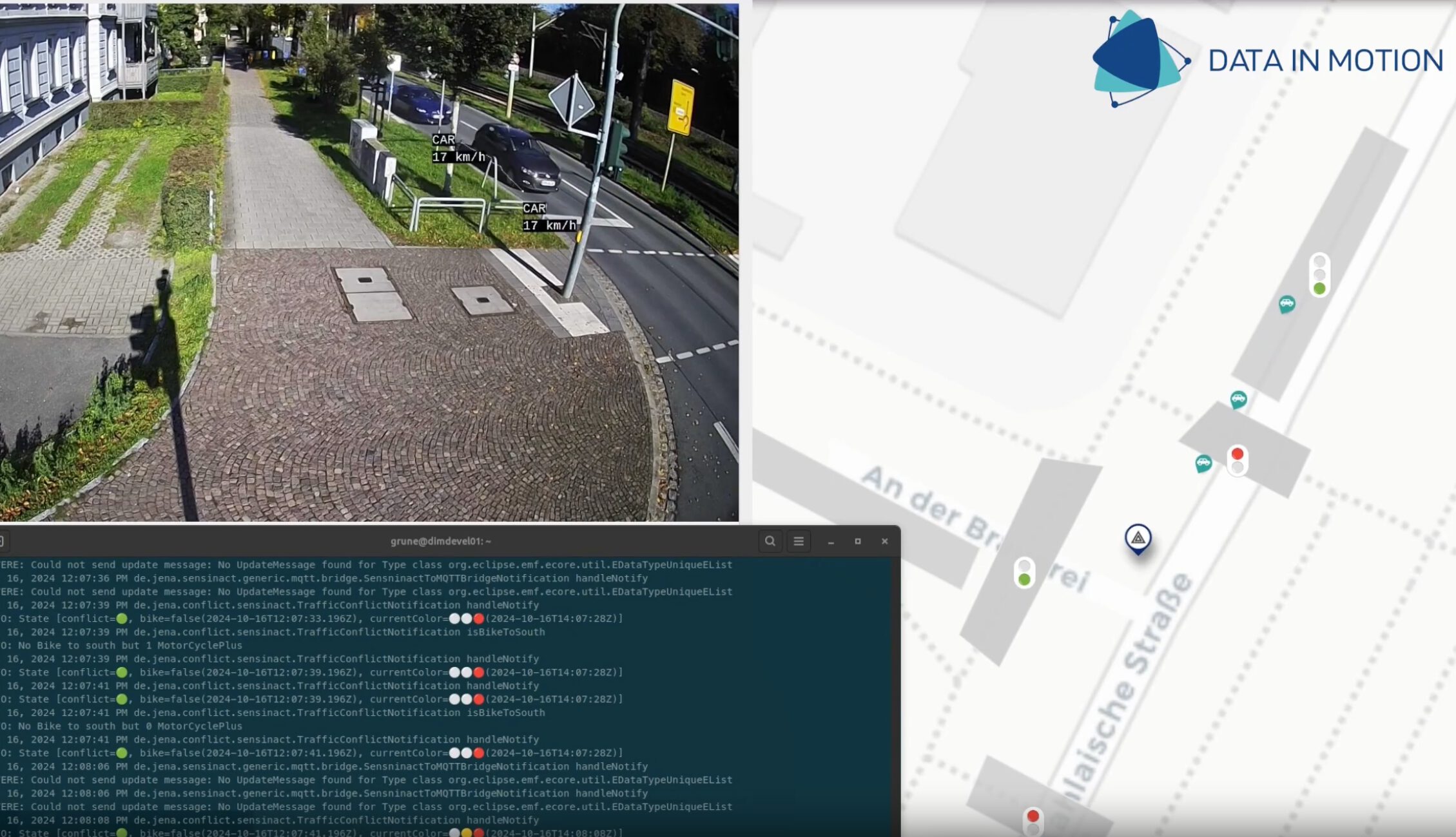
In practice at the City of Jena (since 2020): production integration of LoRaWAN sensor networks (soil moisture, waste bins, asset tracking), public transport telemetry, and traffic signal systems; real-time Traffic Conflict Detection combining signal state and sensor streams to detect emerging traffic conflicts in real time; and a Traffic Signal Control integration layer making proprietary traffic light hardware readable as structured data streams without hardware replacement.
The open-source stack has since been applied in further project contexts beyond Jena.
Data Governance & Compliance Platform
Regulatory requirements such as GDPR, ISO 27001, KRITIS, CRA, and EU AI Act are only manageable if an organisation has a clear, accurate picture of its own system and data landscape. Our platform maps existing data structures and processes as computable models — without migrating or modifying source systems. Compliance rules are encoded formally in adaptable Policy Packs rather than stored as documents, enabling automated checks across the entire organisation. The Policy & Governance Engine operates at both schema level (design-time analysis) and data level (run-time analysis of actual records). Every finding — automated detection, human judgment, signed approval, re-validation — is captured in a tamper-proof audit trail via the Digital Notary (cryptographically sealed, independently verifiable), giving auditors conclusive, citable proof at any time.
For organisations with opaque or complex IT landscapes, the Data & Infrastructure Command Graph provides an automated entry point: it reverse-engineers existing systems and schemas (Oracle, SAP HANA, PostgreSQL, OpenAPI, SOAP/WSDL, and more) into a continuously updated, queryable model of how data and systems relate — the factual basis for any governance initiative.
Evidence-Based RAG & AI Integration
Our MCP Server exposes the full knowledge stock held in the Model Atlas — governance models, data lineage, technical documentation, domain schemas, and audit history — as structured, typed tool endpoints for any LLM (Claude, OpenAI, Gemini, or self-hosted). Unlike generic document retrieval, answers are grounded in formally typed models, enabling queries that combine static domain knowledge with live operational state. All AI-generated outputs pass through the same governance and approval workflow as any manual process, with a full audit trail via the Digital Notary.