
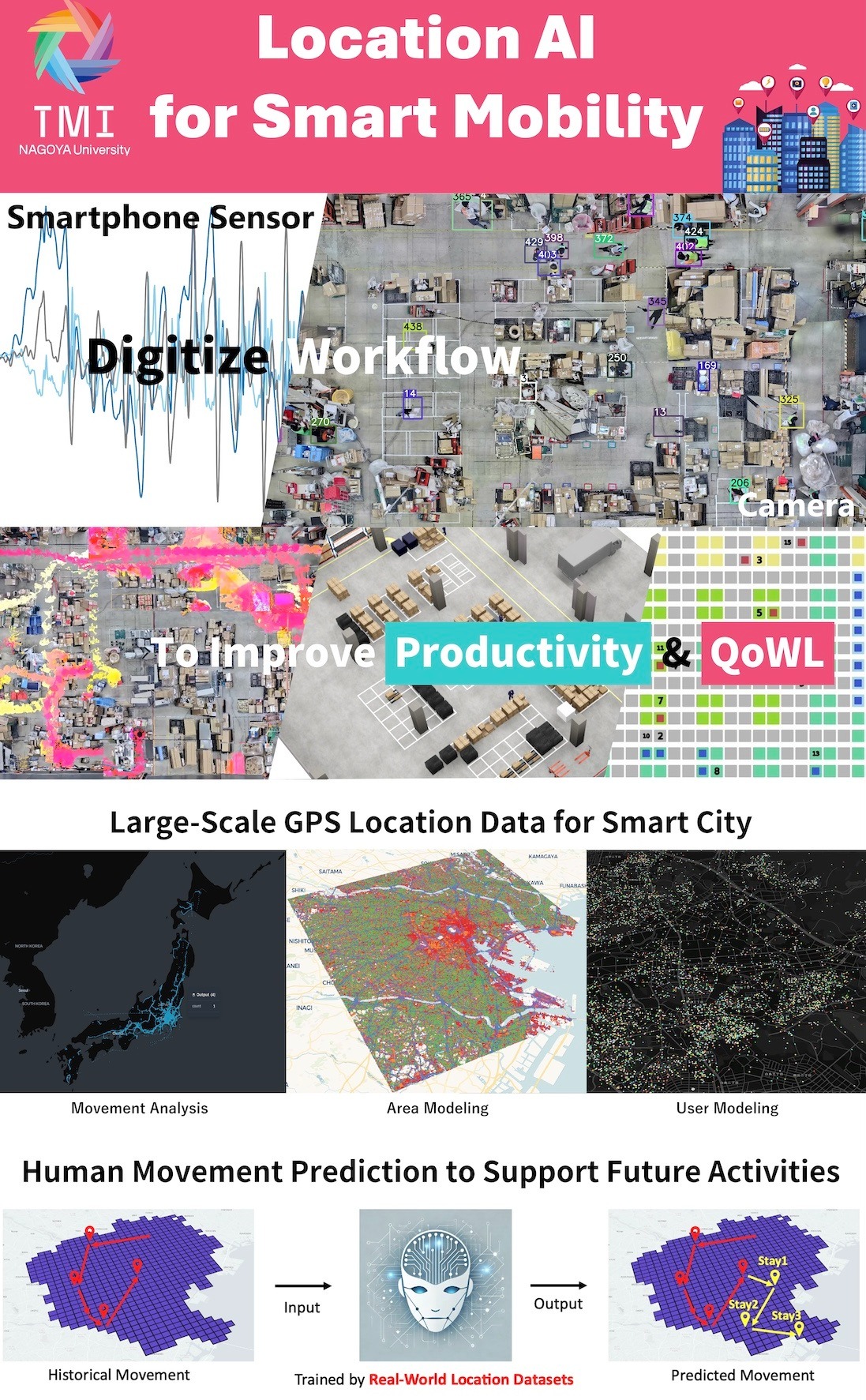
UTA Member, Nagoya University has launched two innovative programs, the Transdisciplinary Mobility Innovation (TMI) program and the onoMAtoPoeiAR project, focusing on advancing urban mobility and enhancing exploration experiences. These initiatives were presented to an international audience during the Smart City Expo World Congress 2024 in Barcelona, where the university joined UTA’s booth.
TMI: Transdisciplinary Approaches to Urban Life Innovation
Nagoya University’s graduate program, TMI (Transdisciplinary Mobility Innovation), fosters collaboration across disciplines such as humanities, social sciences, engineering, informatics, and environmental studies to drive urban innovation.
Two TMI research teams presented their work:
1. Location AI for Smart Cities:
This team leverages human flow data to develop practical applications for urban environments. Their work includes:
- Digital Twins for Logistics: Creating digital representations of workers’ locations and statuses in logistics warehouses, enhancing productivity and resource use.
- Human Mobility Prediction: Using deep learning models to forecast human movement, enabling better urban planning and daily life improvements.
- Data-Driven Community Decisions in Takayama City: Experimental initiatives, including collaboration with local high schools, to integrate data into municipal decision-making processes.
2.OonoMAtoPoeiAR: Enhancing Urban Exploration
The second project, “onoMAtoPoeiAR,” demonstrated a novel map application that combines augmented reality (AR) and onomatopoeia—words that mimic sensory experiences like sounds and movements—to transform urban exploration.
Using a large language model (LLM), the app analyzes user reviews to generate unique onomatopoeic expressions for various locations. These expressions are displayed in real time on an interactive map, enriching the sensory experience of navigating urban environments. The project offers particular benefits for:
- Inclusivity: Supporting individuals with disabilities, children, and the elderly by visualizing environmental information in an intuitive way.
- Engagement: Creating a vivid and accessible interaction with urban spaces for tourists and locals alike.
By addressing challenges in urban mobility and accessibility, these projects demonstrate multidisciplinary approaches to improving city living and exploration.