
Yet a recent report by the Chartered Management Institute, Artificial Intelligence: Real Leadership – The Management Imperative in AI Adoption, offers a much more nuanced perspective. While public discussions often focus on algorithms, automation and technological capabilities, the report arrives at a different conclusion: the greatest challenge of AI adoption is not technology. It is leadership.
This conclusion is particularly relevant for cities and public sector organisations currently pursuing digital transformation agendas.
The AI paradox
The report reveals an interesting contradiction.
Around 70% of managers report productivity improvements from AI adoption. However, only 5% describe these improvements as transformational. Most benefits remain concentrated in routine efficiency gains, faster content generation, administrative support and information processing.
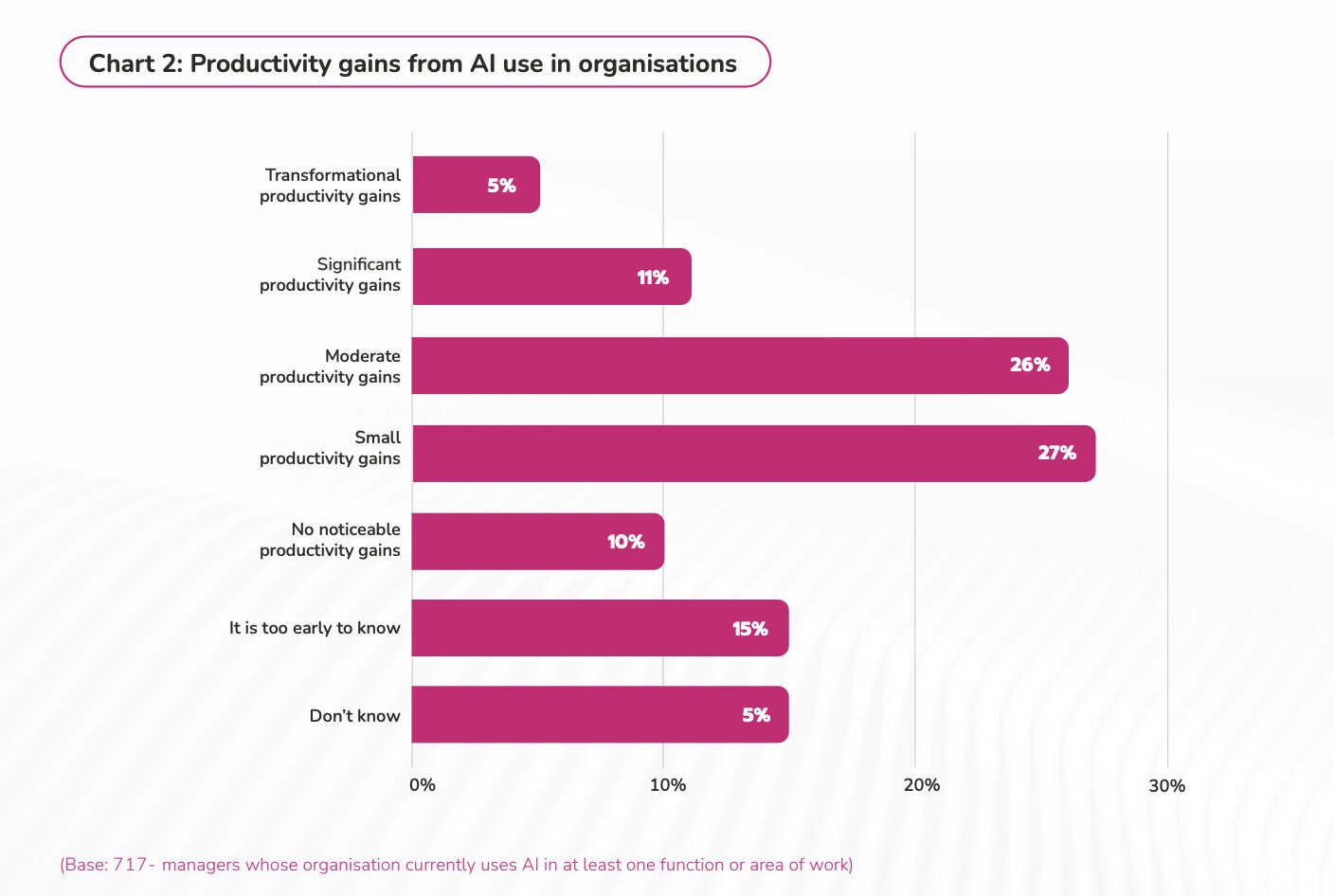
In other words, AI is already helping organisations work faster.
But it is not yet helping them think better.
This distinction matters.
For cities, metropolitan authorities and public administrations, the most important decisions are rarely routine. They involve competing priorities, political considerations, stakeholder interests, budget constraints, environmental impacts and long-term societal consequences.
These are precisely the areas where human judgement remains irreplaceable.
From information scarcity to information abundance
For decades, leadership was often constrained by limited access to information.
Today, AI has fundamentally changed that equation.
The challenge is no longer obtaining information. The challenge is evaluating it.
Generative AI can now produce policy drafts, strategic plans, reports, roadmaps, risk assessments and communication materials in minutes. It can summarise thousands of pages of documentation, identify patterns in large datasetsand generate recommendations at unprecedented speed.
However, speed does not guarantee quality.
Nor does confidence guarantee correctness.
As AI-generated outputs become increasingly sophisticated, organisations face a new risk: accepting plausible answers without sufficiently questioning them.
The report repeatedly highlights the growing importance of critical thinking, professional judgement and human oversight in AI-enabled environments. Rather than acting as passive consumers of AI-generated outputs, leaders must become active evaluators of those outputs.
The rise of the “Intelligent Commissioner”
One of the most powerful concepts introduced in the report is the idea of the “Intelligent Commissioner”.
Traditionally, expertise was often associated with producing knowledge.
In the AI era, expertise increasingly means evaluating knowledge.
The Intelligent Commissioner is not necessarily the person writing every report, analysing every dataset or preparing every presentation. Instead, this person understands enough about the problem, the context and the objectives to critically assess the quality of AI-generated outputs.
This requires asking difficult questions:
- Are the assumptions correct?
- Is the data reliable?
- What perspectives may be missing?
- What biases may be influencing the results?
- What are the potential unintended consequences?
- Does this recommendation make sense in the real-world context?
These questions are becoming central to effective leadership.
Why this matters for cities
Cities are among the most complex systems humans have ever created.
Urban leaders must simultaneously address mobility, housing, climate adaptation, public health, social inclusion, energy systems, infrastructure resilience and economic development.
Increasingly, AI will support these decisions.
Digital twins, predictive analytics, intelligent mobility systems, climate modelling platforms and AI-assisted public services are already becoming part of urban governance.
Yet technology alone does not guarantee better decisions.
A digital twin may identify optimal traffic flows.
An AI model may predict energy demand.
A machine-learning algorithm may detect emerging risks.
But none of these systems can determine what a city values most.
They cannot decide how to balance efficiency against equity.
They cannot negotiate competing stakeholder interests.
They cannot define political priorities.
These remain fundamentally human responsibilities.
The future belongs to hybrid intelligence
Perhaps the most important message from the report is that the future is not about humans competing with AI.
It is about humans working effectively alongside AI.
The report describes an emerging world of hybrid human–machine workflows, where AI increasingly performs analytical and repetitive tasks while humans focus on interpretation, governance, creativity, communication and decision-making.
This shift changes the skills that organisations should prioritise.
Technical literacy remains important.
However, the growing differentiators are becoming:
- Critical thinking
- Systems thinking
- Ethical judgement
- Communication
- Stakeholder engagement
- Emotional intelligence
- Leadership under uncertainty
Ironically, the more advanced AI becomes, the more valuable these distinctly human capabilities become.
Moving beyond AI adoption
Many organisations currently focus on questions such as:
“How do we deploy AI?”
“How do we automate processes?”
“How do we increase productivity?”
These are important questions.
But they may no longer be the most important ones.
The more strategic question is:
“How do we build organisations capable of making good decisions in an AI-enabled world?”
For cities and public administrations, this challenge extends beyond technology procurement or software deployment.
It requires investment in leadership development, organisational learning, governance frameworks and the cultivation of critical thinking across all levels of decision-making.
AI may transform how work is performed.
But the quality of outcomes will continue to depend on the quality of human judgement.
And in that sense, the age of Artificial Intelligence may ultimately become the age of more valuable human intelligence.
From Efficiency to Public Value
One of the most interesting themes emerging across recent Smart City discussions is that AI is gradually moving beyond internal productivity tools and becoming part of everyday urban operations.
During the SmartCitiesWorld webinar “AI in City Operations – from Pilots to Everyday Practice”, several practical examples demonstrated how cities are beginning to apply AI to address real societal challenges rather than simply automate administrative tasks.
A particularly compelling example focused on urban heat islands and extreme heat events. As heatwaves become more frequent and intense, cities are increasingly using AI and data analytics to identify neighbourhoods and population groups that face the highest risks.
In some cases, AI systems help local authorities identify elderly residents living alone who may be particularly vulnerable during periods of extreme heat. By combining demographic, environmental and operational data, cities can support social services in prioritisingoutreach efforts and directing resources where they are needed most.
This illustrates an important shift in the role of AI.
The objective is no longer merely to make processes faster. The objective is to improve public outcomes.
The same principle applies across multiple urban domains:
- identifying vulnerable populations during extreme weather events;
- optimising emergency response;
- supporting environmental monitoring;
- improving transport operations;
- prioritising infrastructure maintenance;
- enhancing citizen services.
These examples demonstrate that the true value of AI in cities may not lie in automation itself, but in helping local governments make better-informed, more timely and more equitable decisions.
As cities face increasing climate pressures, ageing populations and growing resource constraints, AI has the potential to become an important tool for resilience and social inclusion.
However, this potential can only be realised when technology is accompanied by strong governance, human oversight and a clear focus on public value.
